Home Mathematics Triangles NCERT Solutions NCERT Examples Example 2 Chapter Select a chapter Chapter 1: Real Numbers Chapter 2: Polynomials Chapter 3: Pair of Linear Equations in Two Variables Chapter 4: Quadratic Equations Chapter 5: Arithmetic Progressions Chapter 6: Triangles Chapter 7: Coordinate Geometry Chapter 8: Introduction to Trigonometry Chapter 9: Some Applications of Trigonometry Chapter 10: Circles Chapter 11: Areas Related to Circles Chapter 12: Surface Areas and Volumes Chapter 13: Statistics Chapter 14: Probability Resource Overview NCERT Examples NCERT Exercises Textbook Previous Year Questions Question Bank HOTS Modules Exercise / Example Select an entry Example 1 Example 2 Example 3 Example 4 Example 5 Example 6 Example 7 Example 8
Mathematics · Chapter 6 · NCERT Examples
← Previous Example Example 1 Next Example Example 3 →Verified NCERT questions and solutions Solutions are checked independently and follow the supplied NCERT chapter edition.
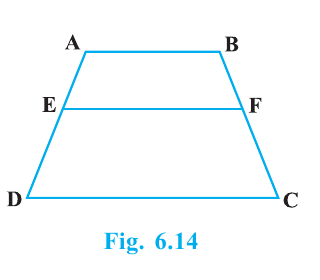
ABCD is a trapezium with AB ∥ DC. E and F are points on the non-parallel sides AD and BC respectively such that EF is parallel to AB. Show that AE/ED = BF/FC.
Figure 6-14 from the supplied NCERT chapter. Solution Board-exam working:
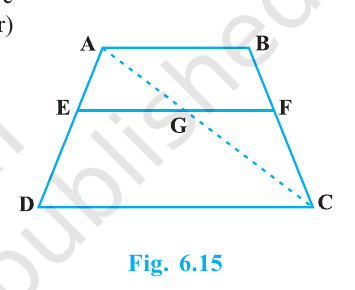
Construction: Join AC and let it intersect EF at G.
Figure 6-15 from the supplied NCERT chapter. Since AB ∥ DC and EF ∥ AB, we also have EF ∥ DC.
In △ADC, EG ∥ DC. By BPT:
In △CAB, GF ∥ AB. By BPT:
Taking reciprocals:
From (1) and (2):
Final answer Therefore, AE/ED = BF/FC.
← Previous Example Example 1 Next Example Example 3 →