Mathematics · Triangles
NCERT Examples
All 8 worked examples from Triangles, with independently verified solutions and direct navigation.
Mathematics · Chapter 6 · NCERT Examples
NCERT Example
Example 1
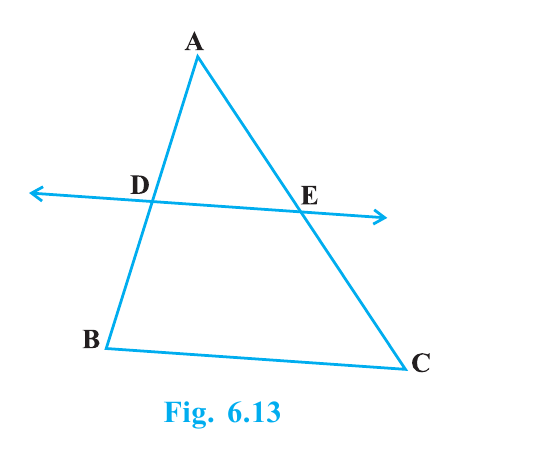
A line intersects sides AB and AC of △ABC at D and E respectively and is parallel to BC. Prove that AD/AB = AE/AC.
Solution
Board-exam working:
Given: DE ∥ BC in △ABC.
By the Basic Proportionality Theorem:
Taking reciprocals:
Adding 1 to both sides:
Taking reciprocals again:
Final answer
Therefore, AD/AB = AE/AC.
NCERT Example
Example 2
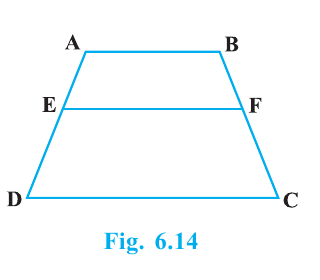
ABCD is a trapezium with AB ∥ DC. E and F are points on the non-parallel sides AD and BC respectively such that EF is parallel to AB. Show that AE/ED = BF/FC.
Solution
Board-exam working:
Construction: Join AC and let it intersect EF at G.
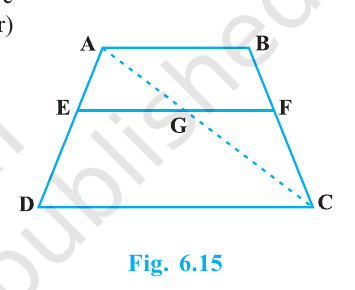
Since AB ∥ DC and EF ∥ AB, we also have EF ∥ DC.
In △ADC, EG ∥ DC. By BPT:
In △CAB, GF ∥ AB. By BPT:
Taking reciprocals:
From (1) and (2):
Final answer
Therefore, AE/ED = BF/FC.
NCERT Example
Example 3
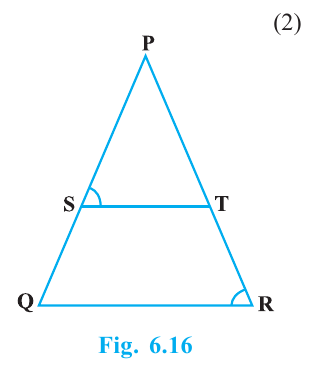
In Figure 6.16, PS/SQ = PT/TR and ∠PST = ∠PRQ. Prove that PQR is an isosceles triangle.
Solution
Board-exam working:
Given:
Since S and T divide PQ and PR in the same ratio, ST ∥ QR by the converse of BPT.
Therefore, ∠PST = ∠PQR because they are corresponding angles.
But ∠PST = ∠PRQ is given. Hence ∠PQR = ∠PRQ.
Sides opposite equal angles of a triangle are equal, so PR = PQ.
Final answer
Therefore, △PQR is isosceles with PQ = PR.
NCERT Example
Example 4
In Figure 6.29, PQ ∥ RS. Prove that △POQ ∼ △SOR.
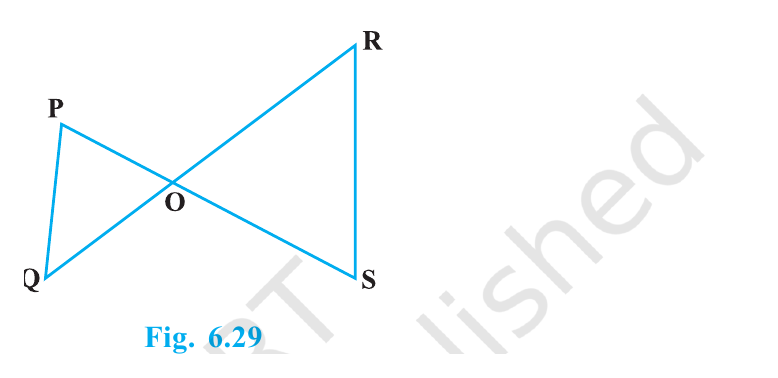
Solution
Board-exam working:
Given: PQ ∥ RS.
∠OPQ = ∠OSR because they are alternate interior angles.
∠OQP = ∠ORS because they are alternate interior angles.
Also, ∠POQ = ∠SOR because they are vertically opposite angles.
Thus the correspondence is P ↔ S, O ↔ O and Q ↔ R.
Therefore, △POQ ∼ △SOR by the AAA similarity criterion.
Final answer
Therefore, △POQ ∼ △SOR.
NCERT Example
Example 5
Observe Figure 6.30 and find ∠P.
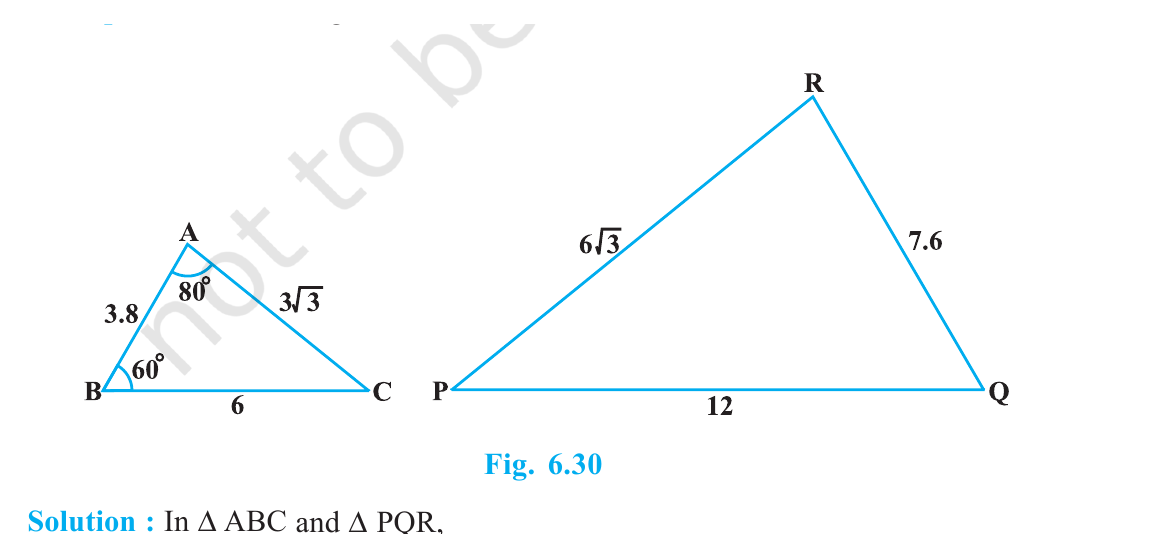
Solution
Board-exam working:
In △ABC and △RQP:
Thus:
Therefore, △ABC ∼ △RQP by SSS similarity.
The verified correspondence is A ↔ R, B ↔ Q and C ↔ P. Hence ∠P = ∠C.
By the angle-sum property, ∠C = 180° − 80° − 60° = 40°.
Final answer
∠P = 40°.
NCERT Example
Example 6
In Figure 6.31, OA × OB = OC × OD. Show that ∠A = ∠C and ∠B = ∠D.
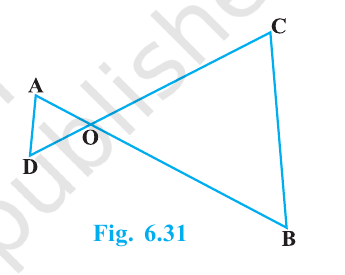
Solution
Board-exam working:
Given: OA × OB = OC × OD.
Dividing both sides by OC × OB:
Also, ∠AOD = ∠COB because they are vertically opposite angles. ...(2)
From (1) and (2), the two sides including the equal angle are proportional.
Therefore, △AOD ∼ △COB by SAS similarity, with A ↔ C and D ↔ B.
Corresponding angles of similar triangles are equal, so ∠A = ∠C and ∠D = ∠B.
Final answer
∠A = ∠C and ∠B = ∠D.
NCERT Example
Example 7
A girl of height 90 cm is walking away from the base of a lamp-post at 1.2 m/s. If the lamp is 3.6 m above the ground, find the length of her shadow after 4 seconds.
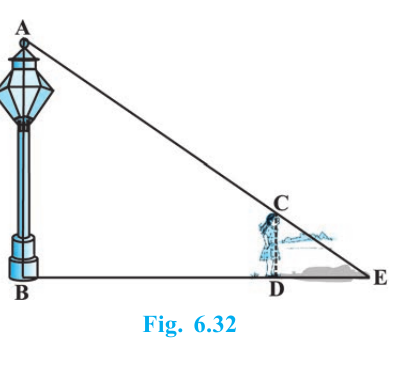
Solution
Board-exam working:
Let DE = x m be the girl's shadow after 4 seconds.
Distance walked, BD = 1.2 × 4 = 4.8 m. Therefore, BE = BD + DE = 4.8 + x metres.
AB = 3.6 m and CD = 90 cm = 0.9 m.
In △ABE and △CDE, ∠B = ∠D = 90° and ∠E is common. Therefore, △ABE ∼ △CDE by AA similarity.
The correspondence is A ↔ C, B ↔ D and E ↔ E. Hence:
Final answer
The girl's shadow is 1.6 m long.
NCERT Example
Example 8
CM and RN are respectively the medians of △ABC and △PQR. If △ABC ∼ △PQR, prove that:
(i) △AMC ∼ △PNR
(ii) CM/RN = AB/PQ
(iii) △CMB ∼ △RNQ
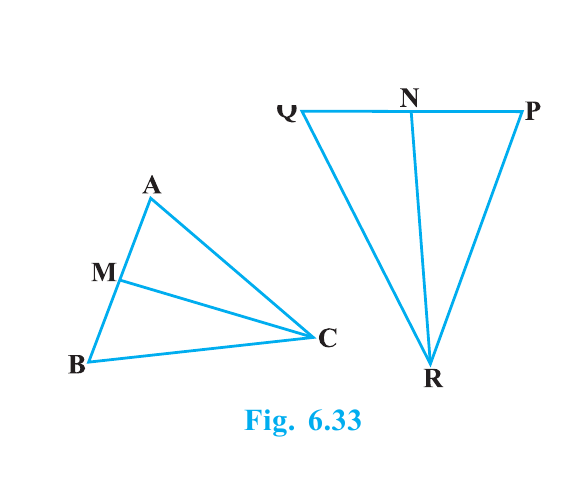
Solution
Board-exam working:
Given △ABC ∼ △PQR, the correspondence is A ↔ P, B ↔ Q and C ↔ R.
Therefore, corresponding sides and angles are equal in ratio:
(i) Since CM and RN are medians:
Also, ∠MAC = ∠NPR because ∠A = ∠P. Therefore, △AMC ∼ △PNR by SAS similarity.
(ii) From △AMC ∼ △PNR:
From (1):
Therefore:
(iii) From (1) and part (ii):
Also:
Thus:
Therefore, △CMB ∼ △RNQ by SSS similarity.
Final answer
(i) △AMC ∼ △PNR; (ii) CM/RN = AB/PQ; (iii) △CMB ∼ △RNQ.