Mathematics · Triangles · NCERT Examples

Example 1

A complete, independently verified solution for NCERT Example 1.

Mathematics · Chapter 6 · NCERT Examples

Verified NCERT questions and solutionsSolutions are checked independently and follow the supplied NCERT chapter edition.

NCERT Example

Example 1

A line intersects sides AB and AC of △ABC at D and E respectively and is parallel to BC. Prove that AD/AB = AE/AC.
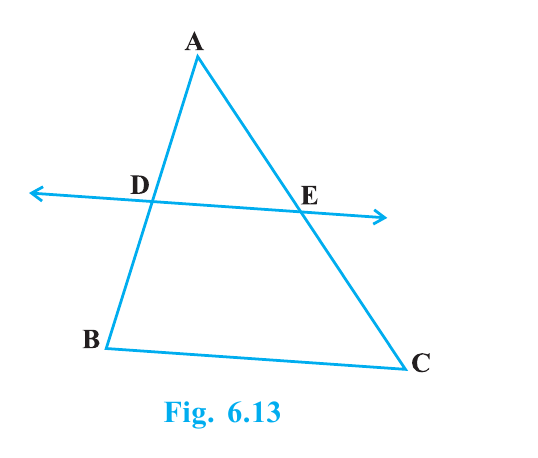
Triangle ABC with D on AB, E on AC, and line DE parallel to BC.
Figure 6-13 from the supplied NCERT chapter.

Solution

Given:

In triangle ABC, D lies on AB, E lies on AC and DE is parallel to BC.

To prove:

AD/AB = AE/AC.

Triangle ABC with D on AB, E on AC, and line DE parallel to BC.
Figure 6-13 from the supplied NCERT chapter.

Proof:

By the Basic Proportionality Theorem:

ADDB=AEEC\frac{AD}{DB}=\frac{AE}{EC}

Taking reciprocals:

DBAD=ECAE\frac{DB}{AD}=\frac{EC}{AE}

Adding 1 to both sides:

DBAD+1=ECAE+1\frac{DB}{AD}+1=\frac{EC}{AE}+1
DB+ADAD=EC+AEAE\frac{DB+AD}{AD}=\frac{EC+AE}{AE}
ABAD=ACAE\frac{AB}{AD}=\frac{AC}{AE}

Taking reciprocals again:

ADAB=AEAC\frac{AD}{AB}=\frac{AE}{AC}

Final answer

Therefore, AD/AB = AE/AC.

Study assistant

Padhona AI

Ask about anything you’re studying.

Contextual study help

Ask about what you’re studying

Sign in to use contextual Padhona AI on study pages.

  • Padhona AI understands the question you’re viewing
  • Ask about a step without copying the whole question
  • Free accounts get 10 contextual messages per day