Mathematics · Coordinate Geometry · NCERT Exercises
Exercise 7.2
Complete, independently verified solutions for NCERT Exercise 7.2.
Mathematics · Chapter 7 · NCERT Exercises
Question
Question 1
Find the coordinates of the point which divides the line segment joining A(-1, 7) and B(4, -3) internally in the ratio 2 : 3.
Solution
Board-exam working:
Using the section formula for the ratio 2 : 3:
Calculate the x-coordinate:
Calculate the y-coordinate:
Final answer
The required point is (1, 3).
Question
Question 2
Find the coordinates of the points of trisection of the line segment joining A(4, -1) and B(-2, -3).
Solution
Board-exam working:
Let P and Q be the trisection points, so AP = PQ = QB.
Point P divides AB internally in the ratio 1 : 2.
Point Q divides AB internally in the ratio 2 : 1.
Final answer
The trisection points are:
Question
Question 3
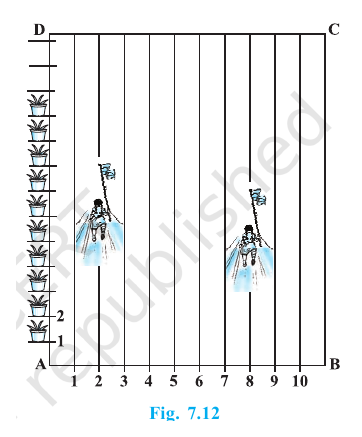
In the rectangular school ground shown in Figure 7.12, 100 flower pots are placed 1 m apart along AD. Niharika runs one-fourth of AD on the second line and places a green flag. Preet runs one-fifth of AD on the eighth line and places a red flag. Find the distance between the flags and the point where Rashmi should place a blue flag halfway between them.
Solution
Board-exam working:
Take A as the origin, the running-line number as the x-coordinate, and the distance along AD as the y-coordinate.
Niharika is on the second line and covers one-fourth of 100 m:
Therefore, the green flag is at G(2, 25).
Preet is on the eighth line and covers one-fifth of 100 m:
Therefore, the red flag is at R(8, 20).
Distance between the flags:
Rashmi must place the blue flag at the midpoint of G and R:
Final answer
The flags are √61 m apart. Rashmi should place the blue flag on the fifth line, 22.5 m from A along AD.
Question
Question 4
Find the ratio in which P(-1, 6) divides the line segment joining A(-3, 10) and B(6, -8).
Solution
Board-exam working:
Let P divide AB internally in the ratio m : n.
Using the x-coordinate in the section formula:
Cross multiplying:
Verification using the y-coordinate:
Final answer
P divides AB internally in the ratio 2 : 7.
Question
Question 5
Find the ratio in which the x-axis divides the line segment joining A(1, -5) and B(-4, 5). Also find the point of division.
Solution
Board-exam working:
Let the x-axis meet AB at P and let AP : PB = m : n.
Since P lies on the x-axis, its y-coordinate is 0.
Thus P is the midpoint of AB.
Final answer
The ratio is 1 : 1, and the point of division is:
Question
Question 6
If A(1, 2), B(4, y), C(x, 6) and D(3, 5) are the vertices of a parallelogram in order, find x and y.
Solution
Board-exam working:
The diagonals of a parallelogram bisect each other. Therefore, the midpoint of AC equals the midpoint of BD.
Midpoint of AC:
Midpoint of BD:
Equating x-coordinates:
Equating y-coordinates:
Final answer
x = 6 and y = 3.
Question
Question 7
Find the coordinates of A if AB is a diameter of a circle whose centre is O(2, -3) and B is (1, 4).
Solution
Board-exam working:
Let A = (x, y). Since O is the centre of the circle, O is the midpoint of diameter AB.
Using the midpoint formula:
Equating x-coordinates:
Equating y-coordinates:
Final answer
A = (3, -10).
Question
Question 8
A and B are (-2, -2) and (2, -4). Find P on AB such that:
Solution
Board-exam working:
Since AP is three-sevenths of AB, the remaining part PB is four-sevenths of AB.
Using the section formula:
Calculate the x-coordinate:
Calculate the y-coordinate:
Final answer
Question
Question 9
Find the coordinates of the three points which divide the line segment joining A(-2, 2) and B(2, 8) into four equal parts.
Solution
Board-exam working:
Let P, Q and R divide AB into four equal parts in that order.
Point P divides AB in the ratio 1 : 3.
Point Q is the midpoint and divides AB in the ratio 1 : 1.
Point R divides AB in the ratio 3 : 1.
Final answer
The three points are:
Question
Question 10
Find the area of the rhombus whose vertices, in order, are A(3, 0), B(4, 5), C(-1, 4) and D(-2, -1).
Solution
Board-exam working:
The diagonals are AC and BD.
Length of AC:
Length of BD:
Area of a rhombus:
Final answer
The area of the rhombus is 24 square units.