Mathematics · Coordinate Geometry · NCERT Exercises
Exercise 7.1
Complete, independently verified solutions for NCERT Exercise 7.1.
Mathematics · Chapter 7 · NCERT Exercises
Question
Question 1
Find the distance between each pair of points:
(i) (2, 3) and (4, 1)
(ii) (-5, 7) and (-1, 3)
(iii) (a, b) and (-a, -b)
Solution
Board-exam working:
Use the distance formula:
(i)
(ii)
(iii)
Final answer
(i) 2√2 units; (ii) 4√2 units; (iii) 2√(a² + b²) units.
Question
Question 2
Find the distance between (0, 0) and (36, 15). Hence find the distance between towns A and B discussed in Section 7.2.
Solution
Board-exam working:
Using the distance formula:
Since one coordinate unit represents 1 km, the distance between the towns is 39 km.
Final answer
The distance is 39 units, so towns A and B are 39 km apart.
Question
Question 3
Determine whether A(1, 5), B(2, 3) and C(-2, -11) are collinear.
Solution
Board-exam working:
Calculate the three distances:
For three collinear points, one distance must equal the sum of the other two.
No one of the three distances equals the sum of the other two. Therefore, the points are not collinear.
Final answer
The three points are not collinear.
Question
Question 4
Check whether A(5, -2), B(6, 4) and C(7, -2) are the vertices of an isosceles triangle.
Solution
Board-exam working:
Using the distance formula:
Two sides are equal. Therefore, △ABC is an isosceles triangle with base AC.
Final answer
Yes. The points form an isosceles triangle with AB = BC = √37 units.
Question
Question 5
In Figure 7.8, four friends sit at A(3, 4), B(6, 7), C(9, 4) and D(6, 1). Champa says ABCD is a square, while Chameli disagrees. Use the distance formula to decide who is correct.
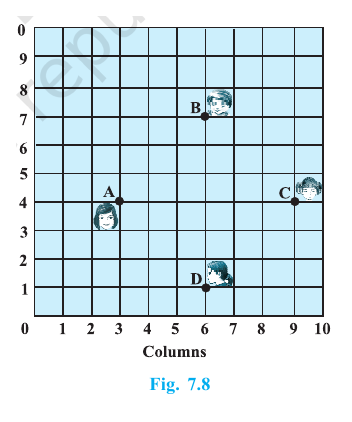
Solution
Board-exam working:
Calculate the four sides:
Now calculate the diagonals:
All four sides are equal and the diagonals are equal. Therefore, ABCD is a square.
Final answer
Champa is correct: ABCD is a square.
Question
Question 6
Name the type of quadrilateral formed, if any, by each ordered set of points. Give reasons:
(i) (-1, -2), (1, 0), (-1, 2), (-3, 0)
(ii) (-3, 5), (3, 1), (0, 3), (-1, -4)
(iii) (4, 5), (7, 6), (4, 3), (1, 2)
Solution
Board-exam working:
Let the four points in each part be A, B, C and D in the given order.
(i) Calculate the sides:
Calculate the diagonals:
All four sides are equal and both diagonals are equal. Therefore, ABCD is a square.
(ii) Calculate the sides:
Therefore, A, C and B are collinear. Three of the given points lie on one straight line, so the four points do not form a quadrilateral.
(iii) Calculate the sides:
Both pairs of opposite sides are equal. Therefore, ABCD is a parallelogram.
Final answer
(i) Square; (ii) no quadrilateral; (iii) parallelogram.
Question
Question 7
Find the point on the x-axis which is equidistant from A(2, -5) and B(-2, 9).
Solution
Board-exam working:
A point on the x-axis has y-coordinate 0. Let the required point be P(x, 0).
Since P is equidistant from A and B:
Squaring both sides:
Expanding:
Final answer
The required point is (-7, 0).
Question
Question 8
Find the values of y for which the distance between P(2, -3) and Q(10, y) is 10 units.
Solution
Board-exam working:
Using the distance formula:
Squaring both sides:
Therefore:
Final answer
y = 3 or y = -9.
Question
Question 9
Q(0, 1) is equidistant from P(5, -3) and R(x, 6). Find x. Also find QR and PR.
Solution
Board-exam working:
First calculate QP²:
Since Q is equidistant from P and R:
In both cases:
When x = 4, R = (4, 6):
When x = -4, R = (-4, 6):
Final answer
x = 4 or -4; QR = √41 units. PR = √82 units when x = 4, and 9√2 units when x = -4.
Question
Question 10
Find a relation between x and y such that P(x, y) is equidistant from A(3, 6) and B(-3, 4).
Solution
Board-exam working:
Since P is equidistant from A and B:
Squaring both sides:
Expanding:
Cancelling equal terms and simplifying:
Final answer
The required relation is 3x + y - 5 = 0.