Mathematics · Triangles · NCERT Exercises
Exercise 6.3
Complete, independently verified solutions for NCERT Exercise 6.3.
Mathematics · Chapter 6 · NCERT Exercises
Question
Question 1
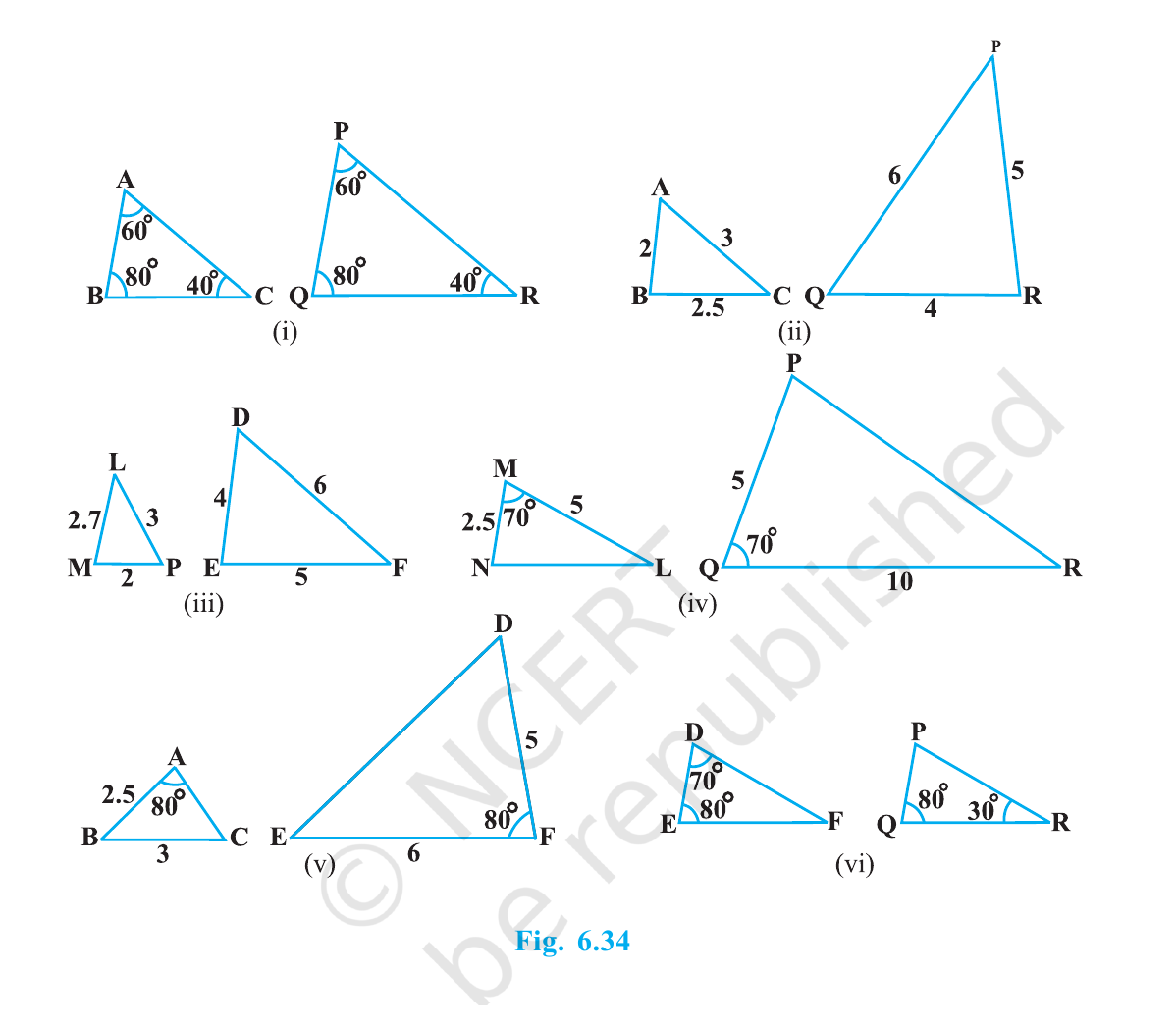
State which pairs of triangles in Figure 6.34 are similar. Give the similarity criterion and write each similar pair in symbolic form.
Solution
Board-exam working:
(i)
Therefore, △ABC ∼ △PQR by AAA similarity.
(ii)
All three corresponding side ratios are equal. Therefore, △ABC ∼ △QRP by SSS similarity.
(iii)
All three corresponding side ratios are not equal. Therefore, the triangles are not similar.
(iv)
The included angles are equal and the surrounding sides are proportional. Therefore, △MNL ∼ △QPR by SAS similarity.
(v)
The included angles are equal and the surrounding sides are proportional. Therefore, △ABC ∼ △DFE by SAS similarity.
(vi)
Therefore, △DEF ∼ △PQR by AAA similarity.
Final answer
Similar pairs: (i), (ii), (iv), (v) and (vi). Pair (iii) is not similar.
Question
Question 2
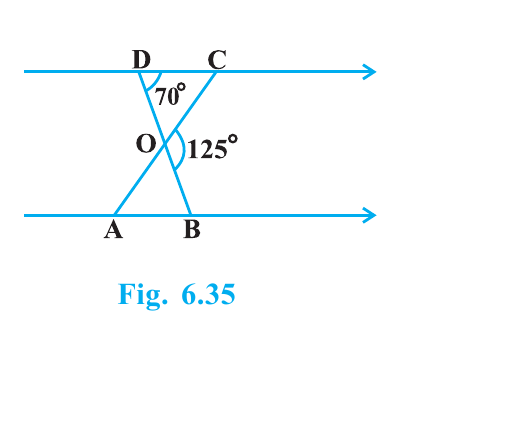
In Figure 6.35, △ODC ∼ △OBA, ∠BOC = 125° and ∠CDO = 70°. Find ∠DOC, ∠DCO and ∠OAB.
Solution
Board-exam working:
∠DOC and ∠BOC form a linear pair.
In △ODC, by the angle-sum property:
Given △ODC ∼ △OBA, the correspondence is O ↔ O, D ↔ B and C ↔ A.
Therefore, as corresponding angles:
Final answer
∠DOC = 55°, ∠DCO = 55°, and ∠OAB = 55°.
Question
Question 3
Diagonals AC and BD of trapezium ABCD, with AB ∥ DC, intersect at O. Using a similarity criterion, show that OA/OC = OB/OD.
Solution
Board-exam working:
Consider △AOB and △COD.
∠AOB = ∠COD because they are vertically opposite angles.
∠ABO = ∠CDO because AB ∥ DC and BD is a transversal.
Therefore, △AOB ∼ △COD by AA similarity, with A ↔ C, O ↔ O and B ↔ D.
Hence corresponding sides are proportional:
Final answer
Therefore, OA/OC = OB/OD.
Question
Question 4
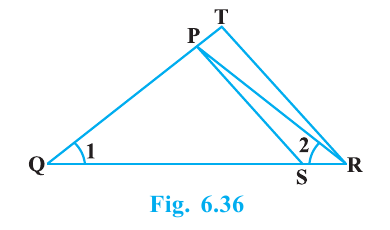
In Figure 6.36, QR/QS = QT/PR and ∠1 = ∠2. Show that △PQS ∼ △TQR.
Solution
Board-exam working:
In △PQR, ∠1 = ∠2 is given. Therefore, the sides opposite these equal angles are equal: PR = PQ.
Substitute PR = PQ in the given proportion:
Taking reciprocals:
Since P lies on QT and S lies on QR, ∠PQS = ∠TQR. ...(2)
From (1) and (2), the sides including the equal angle are proportional.
Therefore, △PQS ∼ △TQR by SAS similarity, with P ↔ T, Q ↔ Q and S ↔ R.
Final answer
Therefore, △PQS ∼ △TQR.
Question
Question 5
S and T are points on sides PR and QR of △PQR such that ∠P = ∠RTS. Show that △RPQ ∼ △RTS.
Solution
Board-exam working:
Given ∠RPQ = ∠RTS.
Since S lies on PR and T lies on QR, rays RS and RP are collinear and rays RT and RQ are collinear.
Therefore, ∠PRQ = ∠TRS.
Thus two corresponding angles are equal, with R ↔ R, P ↔ T and Q ↔ S.
Hence △RPQ ∼ △RTS by AA similarity.
Final answer
Therefore, △RPQ ∼ △RTS.
Question
Question 6
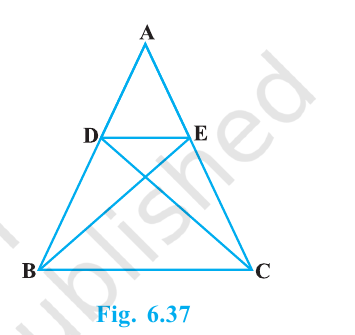
In Figure 6.37, if △ABE ≅ △ACD, show that △ADE ∼ △ABC.
Solution
Board-exam working:
Given △ABE ≅ △ACD.
By corresponding parts of congruent triangles:
Therefore:
Also, because AD lies on AB and AE lies on AC:
The two pairs of sides including the common angle are proportional.
Hence △ADE ∼ △ABC by SAS similarity, with A ↔ A, D ↔ B and E ↔ C.
Final answer
Therefore, △ADE ∼ △ABC.
Question
Question 7
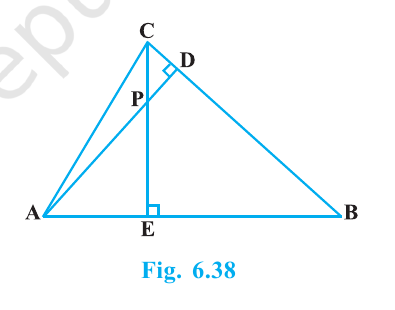
In Figure 6.38, altitudes AD and CE of △ABC intersect at P. Show that:
(i) △AEP ∼ △CDP
(ii) △ABD ∼ △CBE
(iii) △AEP ∼ △ADB
(iv) △PDC ∼ △BEC
Solution
Board-exam working:
Since AD and CE are altitudes, AD ⟂ BC and CE ⟂ AB.
(i)
The second pair is vertically opposite. Therefore, △AEP ∼ △CDP by AA similarity.
(ii)
Here BD lies on BC and BE lies on BA. Therefore, △ABD ∼ △CBE by AA similarity.
(iii)
The angle between AD and CE equals the angle between their perpendiculars BC and AB. Hence:
Therefore, △AEP ∼ △ADB by AA similarity.
(iv)
Here PC and CE are the same line, while CD and CB are the same line. Therefore, △PDC ∼ △BEC by AA similarity.
Final answer
All four required pairs are similar by AA similarity.
Question
Question 8
E is a point on side AD produced of parallelogram ABCD, and BE intersects CD at F. Show that △ABE ∼ △CFB.
Solution
Board-exam working:
In parallelogram ABCD, AB ∥ CD and AD ∥ BC.
Since F lies on CD, CF ∥ AB. Since E lies on AD produced, AE ∥ CB.
Therefore, ∠ABE = ∠CFB because AB ∥ CF and BE is a transversal.
Also, ∠BAE = ∠FCB because AB ∥ CF and AE ∥ CB.
Hence △ABE ∼ △CFB by AA similarity, with A ↔ C, B ↔ F and E ↔ B.
Final answer
Therefore, △ABE ∼ △CFB.
Question
Question 9
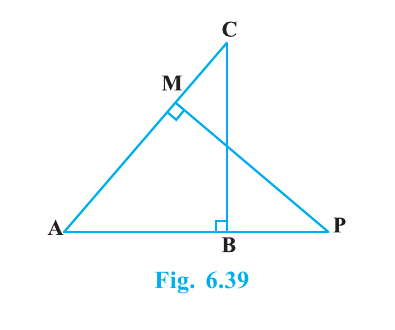
In Figure 6.39, ABC and AMP are right triangles, right-angled at B and M respectively. Prove that:
(i) △ABC ∼ △AMP
(ii) CA/PA = BC/MP
Solution
Board-exam working:
(i)
The second pair is equal because BA and AP are the same straight line, while AC and AM are the same straight line.
Therefore, △ABC ∼ △AMP by AA similarity, with A ↔ A, B ↔ M and C ↔ P.
(ii) Corresponding sides of similar triangles are proportional.
Here CA corresponds to PA and BC corresponds to MP. Therefore:
Final answer
(i) △ABC ∼ △AMP; (ii) CA/PA = BC/MP.
Question
Question 10
CD and GH are respectively the bisectors of ∠ACB and ∠EGF, with D on AB and H on FE. If △ABC ∼ △FEG, show that:
(i) CD/GH = AC/FG
(ii) △DCB ∼ △HGE
(iii) △DCA ∼ △HGF
Solution
Board-exam working:
Given △ABC ∼ △FEG, the correspondence is A ↔ F, B ↔ E and C ↔ G.
Since CD and GH bisect equal angles C and G:
(ii)
This follows because ∠B = ∠E. Therefore, △DCB ∼ △HGE by AA similarity.
From this similarity:
Combining this with (1):
This proves part (i).
(iii)
The second pair is equal because ∠A = ∠F. Therefore, △DCA ∼ △HGF by AA similarity.
Final answer
(i) CD/GH = AC/FG; (ii) △DCB ∼ △HGE; (iii) △DCA ∼ △HGF.
Question
Question 11
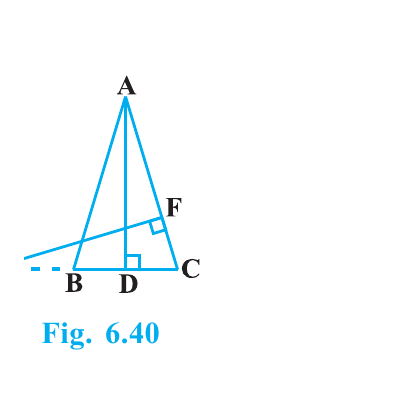
In Figure 6.40, E is on side CB produced of isosceles △ABC with AB = AC. If AD ⟂ BC and EF ⟂ AC, prove that △ABD ∼ △ECF.
Solution
Board-exam working:
Since AD ⟂ BC and EF ⟂ AC, ∠ADB = ∠EFC = 90°.
Because AB = AC, the base angles of isosceles △ABC are equal: ∠ABC = ∠BCA.
D lies on BC, so ∠ABD = ∠ABC. E, B, D and C are collinear and F lies on AC, so ∠ECF = ∠BCA.
Therefore, ∠ABD = ∠ECF.
Hence △ABD ∼ △ECF by AA similarity, with A ↔ E, B ↔ C and D ↔ F.
Final answer
Therefore, △ABD ∼ △ECF.
Question
Question 12
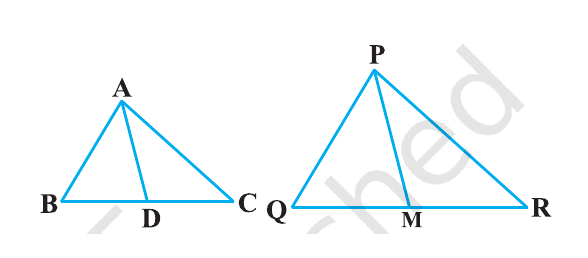
Sides AB and BC and median AD of △ABC are respectively proportional to sides PQ and QR and median PM of △PQR. Show that △ABC ∼ △PQR.
Solution
Board-exam working:
Let the common proportionality ratio be k:
Since AD and PM are medians:
Therefore:
Thus, in △ABD and △PQM:
Therefore, △ABD ∼ △PQM by SSS similarity, so ∠ABD = ∠PQM.
Because D lies on BC and M lies on QR, ∠ABD = ∠ABC and ∠PQM = ∠PQR. Hence ∠ABC = ∠PQR.
Also:
The included angles are equal. Therefore, △ABC ∼ △PQR by SAS similarity.
Final answer
Therefore, △ABC ∼ △PQR.
Question
Question 13
D is a point on side BC of △ABC such that ∠ADC = ∠BAC. Show that CA² = CB × CD.
Solution
Board-exam working:
Consider △ADC and △BAC.
∠ADC = ∠BAC is given.
Since D lies on BC, ∠ACD = ∠BCA.
Therefore, △ADC ∼ △BAC by AA similarity, with A ↔ B, D ↔ A and C ↔ C.
Corresponding sides give:
Cross multiplying:
Final answer
Therefore, CA² = CB × CD.
Question
Question 14
Sides AB and AC and median AD of △ABC are respectively proportional to sides PQ and PR and median PM of △PQR. Show that △ABC ∼ △PQR.
Solution
Board-exam working:
Let the common proportionality ratio be k:
Therefore:
By Apollonius' theorem in △ABC:
Substituting the proportional lengths:
By Apollonius' theorem in △PQR:
From (1) and (2):
Since side lengths are positive:
Therefore:
Hence △ABC ∼ △PQR by SSS similarity, with A ↔ P, B ↔ Q and C ↔ R.
Final answer
Therefore, △ABC ∼ △PQR.
Question
Question 15
A vertical pole 6 m long casts a 4 m shadow. At the same time, a tower casts a 28 m shadow. Find the height of the tower.
Solution
Board-exam working:
Let the height of the tower be h metres.
The pole and tower are vertical, so each forms a right triangle with the ground.
Because the observations are at the same time, the sun's rays make the same angle with the ground. Therefore, the two triangles are similar by AA.
Corresponding height-to-shadow ratios are equal:
Cross multiplying:
Final answer
The tower is 42 m high.
Question
Question 16
AD and PM are medians of △ABC and △PQR respectively, where △ABC ∼ △PQR. Prove that AB/PQ = AD/PM.
Solution
Board-exam working:
Given △ABC ∼ △PQR, with A ↔ P, B ↔ Q and C ↔ R. Therefore:
Since AD and PM are medians:
Hence:
Also, ∠ABD = ∠PQM because D lies on BC, M lies on QR, and ∠ABC = ∠PQR.
From (2) and the included equal angle, △ABD ∼ △PQM by SAS similarity.
Therefore, corresponding sides give:
Final answer
Therefore, AB/PQ = AD/PM.