Mathematics · Triangles · NCERT Exercises
Exercise 6.2
Complete, independently verified solutions for NCERT Exercise 6.2.
Mathematics · Chapter 6 · NCERT Exercises
Question
Question 1
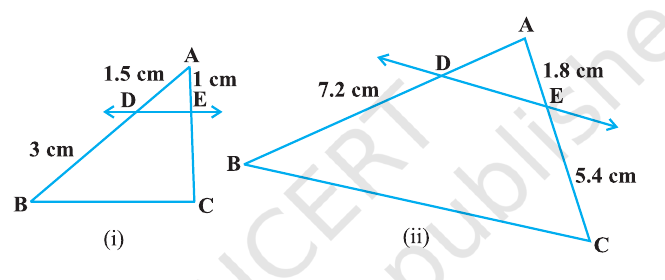
In Figure 6.17 (i) and (ii), DE ∥ BC. Find EC in (i) and AD in (ii).
Solution
Board-exam working:
(i) In △ABC, DE ∥ BC. By BPT:
Substituting AD = 1.5 cm, DB = 3 cm and AE = 1 cm:
(ii) Again, by BPT:
Substituting DB = 7.2 cm, AE = 1.8 cm and EC = 5.4 cm:
Final answer
(i) EC = 2 cm; (ii) AD = 2.4 cm.
Question
Question 2
E and F are points on sides PQ and PR respectively of △PQR. State whether EF ∥ QR in each case:
(i) PE = 3.9 cm, EQ = 3 cm, PF = 3.6 cm and FR = 2.4 cm
(ii) PE = 4 cm, QE = 4.5 cm, PF = 8 cm and RF = 9 cm
(iii) PQ = 1.28 cm, PR = 2.56 cm, PE = 0.18 cm and PF = 0.36 cm
Solution
Board-exam working:
By the converse of BPT, EF ∥ QR when:
(i)
The ratios are unequal. Therefore, EF is not parallel to QR.
(ii)
The ratios are equal. Therefore, EF ∥ QR.
(iii)
The ratios are equal. Therefore, EF ∥ QR.
Final answer
(i) No; (ii) Yes; (iii) Yes.
Question
Question 3
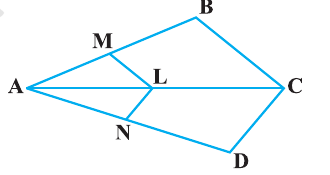
In Figure 6.18, LM ∥ CB and LN ∥ CD. Prove that AM/AB = AN/AD.
Solution
Board-exam working:
In △ABC, LM ∥ CB. By Example 1 (the BPT result using whole sides):
In △ADC, LN ∥ CD. By the same result:
The right-hand sides of (1) and (2) are equal.
Therefore:
Final answer
Therefore, AM/AB = AN/AD.
Question
Question 4
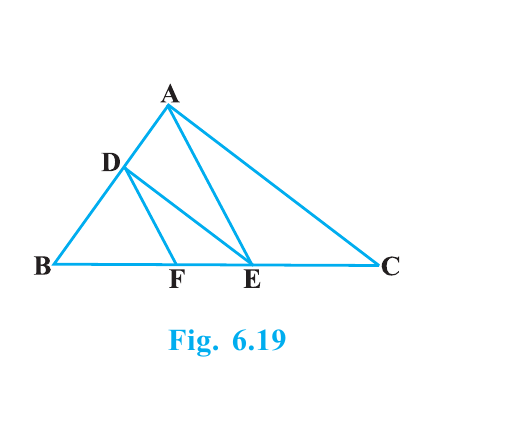
In Figure 6.19, DE ∥ AC and DF ∥ AE. Prove that BF/FE = BE/EC.
Solution
Board-exam working:
In △BAE, DF ∥ AE. By BPT:
In △BAC, DE ∥ AC. By BPT:
The left-hand sides of (1) and (2) are equal.
Therefore:
Final answer
Therefore, BF/FE = BE/EC.
Question
Question 5
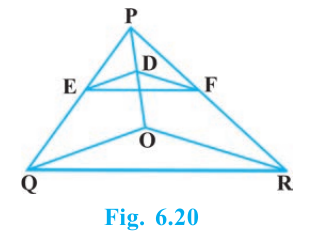
In Figure 6.20, DE ∥ OQ and DF ∥ OR. Show that EF ∥ QR.
Solution
Board-exam working:
In △POQ, DE ∥ OQ. By BPT:
In △POR, DF ∥ OR. By BPT:
From (1) and (2):
Thus E and F divide sides PQ and PR in the same ratio.
Therefore, EF ∥ QR by the converse of BPT.
Final answer
Therefore, EF ∥ QR.
Question
Question 6
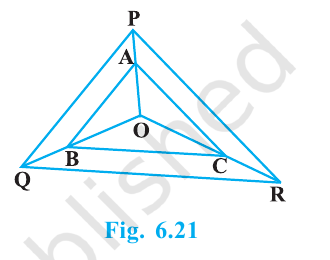
In Figure 6.21, A, B and C are points on OP, OQ and OR respectively such that AB ∥ PQ and AC ∥ PR. Show that BC ∥ QR.
Solution
Board-exam working:
In △OPQ, AB ∥ PQ. By BPT:
In △OPR, AC ∥ PR. By BPT:
From (1) and (2):
Therefore B and C divide OQ and OR in the same ratio.
Hence BC ∥ QR by the converse of BPT.
Final answer
Therefore, BC ∥ QR.
Question
Question 7
Using Theorem 6.1, prove that a line drawn through the midpoint of one side of a triangle parallel to another side bisects the third side.
Solution
Board-exam working:
Given: In △ABC, D is the midpoint of AB. Through D, draw DE ∥ BC meeting AC at E.
Since D is the midpoint of AB, AD = DB. Therefore:
Because DE ∥ BC, BPT gives:
Therefore:
Hence E is the midpoint of AC, and the parallel line bisects the third side.
Final answer
The line parallel to one side bisects the third side.
Question
Question 8
Using Theorem 6.2, prove that the line joining the midpoints of any two sides of a triangle is parallel to the third side.
Solution
Board-exam working:
Given: In △ABC, D and E are the midpoints of AB and AC respectively.
Since D is the midpoint of AB, AD = DB. Therefore:
Since E is the midpoint of AC, AE = EC. Therefore:
Thus:
Therefore, DE ∥ BC by the converse of BPT.
Final answer
The segment joining the two midpoints is parallel to the third side.
Question
Question 9
ABCD is a trapezium in which AB ∥ DC, and its diagonals intersect at O. Show that AO/BO = CO/DO.
Solution
Board-exam working:
Consider △AOB and △COD.
∠AOB = ∠COD because they are vertically opposite angles.
∠ABO = ∠CDO because AB ∥ DC and BD is a transversal.
Therefore, △AOB ∼ △COD by AA similarity, with A ↔ C, O ↔ O and B ↔ D.
Corresponding sides are proportional:
Rearranging:
Final answer
Therefore, AO/BO = CO/DO.
Question
Question 10
The diagonals of quadrilateral ABCD intersect at O such that AO/BO = CO/DO. Show that ABCD is a trapezium.
Solution
Board-exam working:
Given:
Cross multiplying:
Dividing by CO × DO:
Also, ∠AOB = ∠COD because they are vertically opposite angles. ...(2)
From (1) and (2), △AOB ∼ △COD by SAS similarity, with A ↔ C and B ↔ D.
Therefore, ∠ABO = ∠CDO as corresponding angles.
These are alternate interior angles on transversal BD, so AB ∥ DC.
Hence ABCD has one pair of opposite sides parallel and is a trapezium.
Final answer
Therefore, AB ∥ DC and ABCD is a trapezium.