Mathematics · Arithmetic Progressions · NCERT Exercises
Exercise 5.4
Complete, independently verified solutions for NCERT Exercise 5.4.
Mathematics · Chapter 5 · NCERT Exercises
Question
Question 1
Which term of 121,117,113,… is the first negative term?
Solution
Board-exam working:
Here a=121 and d=117−121=−4.
Thus aₙ=121+(n−1)(−4)=125−4n.
For aₙ<0, 125−4n<0, so 125<4n and n>31.25.
The smallest positive integer satisfying this is n=32.
Check the boundary: a₃₁=125−4×31=1, while a₃₂=125−4×32=−3.
Therefore the 32nd term is the first negative term.
Final answer
32nd term (−3).
Question
Question 2
The sum of 3rd and 7th terms is 6 and their product is 8. Find S₁₆.
Solution
Board-exam working:
Let a₃=a+2d and a₇=a+6d.
Their sum is 2a+8d=6, so a+4d=3.
Therefore a₃=3−2d and a₇=3+2d.
Their product is 8: (3−2d)(3+2d)=8.
Thus 9−4d²=8, so 4d²=1 and d=±1/2.
Since a=3−4d, for d=1/2 we get a=1
for d=−1/2 we get a=5.
S₁₆=16/2[2a+15d]=8[2(3−4d)+15d]=8(6+7d)=48+56d.
Hence S₁₆=76 when d=1/2, or S₁₆=20 when d=−1/2.
Final answer
S₁₆=76 or 20.
Question
Question 3
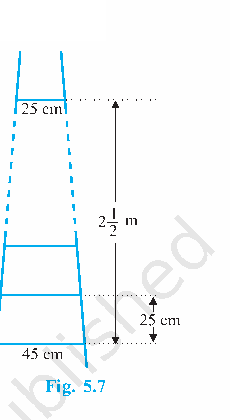
Ladder rungs are 25 cm apart over 2.5 m and decrease from 45 cm to 25 cm. Find wood length for rungs.
Solution
Board-exam working:
Convert 2.5 m to 250 cm.
With 25 cm between consecutive rungs, the number of gaps is 250÷25=10.
Hence the number of rungs is 10+1=11.
The rung lengths decrease uniformly from 45 cm to 25 cm, so they form an AP with a=45,l=25,n=11.
Total wood length=S₁₁=11/2(45+25)=11/2×70=11×35=385 cm=3.85 m.
Final answer
385 cm (3.85 m).
Question
Question 4
Houses are numbered 1–49. Find x where sum before x equals sum after x.
Solution
Board-exam working:
The sum before house x is 1+2+…+(x−1)=x(x−1)/2.
The total from 1 to 49 is 49×50/2=1225.
The sum after x is 1225−x(x+1)/2.
Equate the two sums: x(x−1)/2=1225−x(x+1)/2.
Multiplying by 2 gives x(x−1)+x(x+1)=2450, so 2x²=2450 and x²=1225.
Thus x=±35, but a house number must be positive, so x=35.
Check: 1+…+34=595 and 36+…+49=595.
Final answer
x=35.
Question
Question 5
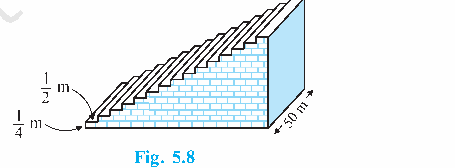
A 15-step terrace is 50 m long; each rise is 1/4 m and tread 1/2 m. Find concrete volume.
Solution
Board-exam working:
The first step layer has cross-sectional area (1/2)(1/4), the second contributes twice this amount, and so on up to 15 layers.
With length 50 m, total volume is 50×1/2×1/4(1+2+…+15).
The sum 1+2+…+15 is 15/2(1+15)=15/2×16=120.
Therefore volume=50×1/2×1/4×120=25/4×120=25×30=750 m³.
Final answer
750 m³.