Mathematics · Arithmetic Progressions · NCERT Exercises
Exercise 5.3
Complete, independently verified solutions for NCERT Exercise 5.3.
Mathematics · Chapter 5 · NCERT Exercises
Question
Question 1
Find sums: (i) 2,7,12,… 10 terms (ii) −37,−33,−29,… 12 terms (iii) 0.6,1.7,2.8,… 100 terms (iv) 1/15,1/12,1/10,… 11 terms.
Solution
Board-exam working:
Use Sₙ=n/2[2a+(n−1)d].
(i) a=2,d=7−2=5,n=10.
S₁₀=10/2[2×2+9×5]=5[4+45]=5×49=245.
(ii) a=−37,d=−33−(−37)=4,n=12.
S₁₂=12/2[2(−37)+11×4]=6[−74+44]=6(−30)=−180.
(iii) a=0.6,d=1.7−0.6=1.1,n=100.
S₁₀₀=100/2[2×0.6+99×1.1]=50[1.2+108.9]=50×110.1=5505.
(iv) a=1/15,d=1/12−1/15=(5−4)/60=1/60,n=11.
S₁₁=11/2[2/15+10/60]=11/2[8/60+10/60]=11/2×3/10=33/20.
Final answer
(i)245; (ii)−180; (iii)5505; (iv)33/20.
Question
Question 2
Find sums: (i) 7+10½+14+…+84 (ii) 34+32+30+…+10 (iii) −5−8−11−…−230.
Solution
Board-exam working:
First find n from l=a+(n−1)d, then use Sₙ=n(a+l)/2.
(i) a=7,d=10½−7=7/2,l=84.
Thus 84=7+(n−1)7/2
77×2=7(n−1), so n−1=22 and n=23.
S₂₃=23/2(7+84)=23×91/2=2093/2.
(ii) a=34,d=−2,l=10.
Thus 10=34−2(n−1)
2(n−1)=24, so n=13.
S₁₃=13/2(34+10)=13/2×44=286.
(iii) a=−5,d=−3,l=−230.
Thus −230=−5−3(n−1)
−225=−3(n−1), so n−1=75 and n=76.
S₇₆=76/2(−5−230)=38(−235)=−8930.
Final answer
(i)2093/2; (ii)286; (iii)−8930.
Question
Question 3
In an AP, solve: (i) a=5,d=3,aₙ=50, find n and Sₙ; (ii) a=7,a₁₃=35, find d and S₁₃; (iii) a=37,d=3, find a₁₂ and S₁₂; (iv) a=15,S₁₀=125, find d and a₁₀; (v) d=5,S₉=75, find a and a₉; (vi) a=2,d=8,Sₙ=90, find n and aₙ; (vii) a=8,aₙ=62,Sₙ=210, find n and d; (viii) a=−4,d=2,Sₙ=−14, find n and aₙ; (ix) a=3,n=8,S₈=192, find d; (x) l=28,S₉=144, find a.
Solution
Board-exam working:
Use aₙ=a+(n−1)d and Sₙ=n(a+aₙ)/2.
(i) 50=5+(n−1)3 gives 45=3(n−1), so n=16.
Then S₁₆=16/2(5+50)=8×55=440.
(ii) 35=7+(13−1)d gives 28=12d, so d=7/3.
Then S₁₃=13/2(7+35)=13×21=273.
(iii) a₁₂=37+(12−1)3=37+33=70.
Then S₁₂=12/2(37+70)=6×107=642.
(iv) Here a=15,n=10,S₁₀=125.
Therefore 125=10/2[2×15+9d]=5(30+9d).
Thus 25=30+9d, so d=−5/9.
Now a₁₀=15+9(−5/9)=10.
(v) Here d=5,n=9,S₉=75.
Therefore 75=9/2[2a+8×5].
Thus 150/9=2a+40, so 2a=−70/3 and a=−35/3.
Now a₉=−35/3+8×5=85/3.
(vi) 90=n/2[2×2+(n−1)8]=n(4n−2).
Thus 2n²−n−45=0=(2n+9)(n−5), so n=5.
Then a₅=2+4×8=34.
(vii) 210=n/2(8+62)=35n, so n=6.
Also 62=8+(6−1)d, hence 54=5d and d=54/5.
(viii) −14=n/2[2(−4)+(n−1)2]=n(n−5).
Thus n²−5n+14=0.
Its discriminant is 25−56=−31, so the printed data has no real or positive-integer n.
(ix) Here a=3,n=8,S₈=192.
Therefore 192=8/2[2×3+7d]=4(6+7d).
Thus 48=6+7d, so 42=7d and d=6.
(x) With l=28,S=144,n=9: 144=9/2(a+28), so 288=9(a+28), a+28=32 and a=4.
Final answer
(i) n=16,Sₙ=440; (ii) d=7/3,S₁₃=273; (iii) a₁₂=70,S₁₂=642; (iv) d=−5/9,a₁₀=10; (v) a=−35/3,a₉=85/3; (vi) n=5,aₙ=34; (vii) n=6,d=54/5; (viii) no real/integer solution for the printed data; (ix) d=6; (x) a=4.
Question
Question 4
How many terms of 9,17,25,… give sum 636?
Solution
Board-exam working:
Here a=9,d=8,Sₙ=636.
636=n/2[2×9+(n−1)8]=n/2[18+8n−8]=n/2(8n+10)=n(4n+5).
Thus 4n²+5n−636=0=(4n+53)(n−12).
Therefore n=12 or n=−53/4.
Reject the negative value.
Check: S₁₂=12/2[18+11×8]=6(18+88)=6×106=636.
Final answer
12 terms.
Question
Question 5
First term 5, last 45, sum 400: find n and d.
Solution
Board-exam working:
Given a=5,l=45,Sₙ=400.
Use Sₙ=n(a+l)/2.
400=n/2(5+45)=25n, so n=400÷25=16.
Now use l=a+(n−1)d: 45=5+(16−1)d=5+15d.
Thus 40=15d and d=40/15=8/3.
Check: S₁₆=16/2(50)=400.
Final answer
n=16,d=8/3.
Question
Question 6
First and last terms are 17 and 350, d=9. Find n and sum.
Solution
Board-exam working:
Given a=17,d=9,l=350.
Use l=a+(n−1)d.
350=17+9(n−1), so 333=9(n−1), n−1=37 and n=38.
S₃₈=38/2(17+350)=19×367=6973.
Check: a₃₈=17+37×9=17+333=350.
Final answer
38 terms; sum 6973.
Question
Question 7
Find S₂₂ when d=7 and a₂₂=149.
Solution
Board-exam working:
Use a₂₂=a+21d.
Therefore 149=a+21×7=a+147, so a=2.
Now S₂₂=22/2(a+a₂₂)=11(2+149)=11×151=1661.
Check with the other formula: 22/2[2×2+21×7]=11(4+147)=1661.
Final answer
1661.
Question
Question 8
Find S₅₁ when second and third terms are 14 and 18.
Solution
Board-exam working:
a₂=a+d=14 and a₃=a+2d=18.
Subtracting gives d=4.
Then a=14−4=10.
a₅₁=a+50d=10+50×4=210.
S₅₁=51/2(a+a₅₁)=51/2(10+210)=51/2×220=51×110=5610.
Final answer
5610.
Question
Question 9
S₇=49 and S₁₇=289. Find Sₙ.
Solution
Board-exam working:
S₇=7/2[2a+6d]=7(a+3d)=49, so a+3d=7.
S₁₇=17/2[2a+16d]=17(a+8d)=289, so a+8d=17.
Subtracting gives 5d=10, so d=2.
Then a+3×2=7 gives a=1.
Therefore Sₙ=n/2[2×1+(n−1)2]=n/2(2n)=n².
Check: S₇=49 and S₁₇=289.
Final answer
Sₙ=n².
Question
Question 10
Show sequences aₙ=3+4n and aₙ=9−5n are APs; find each S₁₅.
Solution
Board-exam working:
(i) a₁=3+4=7,a₂=3+8=11,a₃=3+12=15.
The differences are 11−7=4 and 15−11=4, so it is an AP with a=7,d=4.
Then S₁₅=15/2[2×7+14×4]=15/2(14+56)=15/2×70=525.
(ii) a₁=9−5=4,a₂=9−10=−1,a₃=9−15=−6.
The differences are −1−4=−5 and −6−(−1)=−5, so it is an AP with a=4,d=−5.
Then S₁₅=15/2[2×4+14(−5)]=15/2(8−70)=15/2(−62)=−465.
Final answer
(i) AP,d=4,S₁₅=525; (ii) AP,d=−5,S₁₅=−465.
Question
Question 11
If Sₙ=4n−n², find S₁, S₂, a₂, a₃, a₁₀ and aₙ.
Solution
Board-exam working:
S₁=4(1)−1²=4−1=3 and S₂=4(2)−2²=8−4=4.
a₂=S₂−S₁=4−3=1.
Also S₃=4(3)−3²=12−9=3, so a₃=S₃−S₂=3−4=−1.
In general, aₙ=Sₙ−Sₙ₋₁=[4n−n²]−[4(n−1)−(n−1)²].
Simplifying gives aₙ=5−2n.
Therefore a₁₀=5−2(10)=5−20=−15.
Final answer
3;4;1;−1;−15; aₙ=5−2n.
Question
Question 12
Find the sum of first 40 positive integers divisible by 6.
Solution
Board-exam working:
The numbers are 6,12,18,…, so a=6,d=6,n=40.
The 40th term is a₄₀=6+(40−1)6=6+234=240.
S₄₀=40/2(6+240)=20×246=4920.
Final answer
4920.
Question
Question 13
Find the sum of first 15 multiples of 8.
Solution
Board-exam working:
The multiples are 8,16,24,…, so a=8,d=8,n=15.
The 15th term is a₁₅=8+(15−1)8=8+112=120.
S₁₅=15/2(8+120)=15/2×128=15×64=960.
Final answer
960.
Question
Question 14
Find the sum of odd numbers between 0 and 50.
Solution
Board-exam working:
The odd numbers are 1,3,5,…,49, so a=1,d=2,l=49.
Find n: 49=1+(n−1)2, so 48=2(n−1), n−1=24 and n=25.
S₂₅=25/2(1+49)=25/2×50=25×25=625.
Final answer
625.
Question
Question 15
Daily delay penalty is ₹200,₹250,₹300,… Find total for 30 days.
Solution
Board-exam working:
The daily penalties form an AP with a=₹200,d=₹50,n=30.
S₃₀=30/2[2×200+(30−1)50]=15[400+1450]=15×1850=₹27,750.
Check: the 30th-day penalty is 200+29×50=₹1650, and 30/2(200+1650)=₹27,750.
Final answer
₹27,750.
Question
Question 16
₹700 funds seven prizes, each ₹20 less than the previous. Find the prizes.
Solution
Board-exam working:
Let the first prize be ₹a.
There are n=7 prizes and d=−₹20.
700=7/2[2a+(7−1)(−20)]=7/2(2a−120).
Multiplying by 2/7 gives 200=2a−120, so 2a=320 and a=160.
Subtracting ₹20 successively gives ₹160,₹140,₹120,₹100,₹80,₹60,₹40.
Their sum is ₹700.
Final answer
₹160,₹140,₹120,₹100,₹80,₹60,₹40.
Question
Question 17
Three sections of each Class I–XII plant the class number of trees. Find total.
Solution
Board-exam working:
For one section, the numbers planted by Classes I–XII are 1,2,3,…,12.
This is an AP with a=1,l=12,n=12.
One-section total=12/2(1+12)=6×13=78 trees.
There are three sections, so total=3×78=234 trees.
Final answer
234 trees.
Question
Question 18
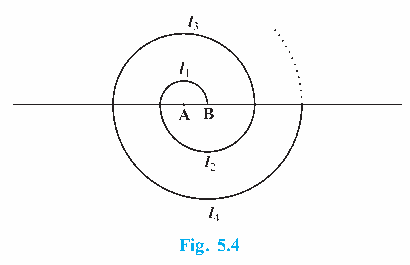
A spiral has 13 semicircles of radii 0.5,1.0,1.5,… cm. Find total length using π=22/7.
Solution
Board-exam working:
The radii form an AP with a=0.5 cm,d=0.5 cm,n=13.
The last radius is l=0.5+12×0.5=6.5 cm.
Sum of radii=13/2(0.5+6.5)=13/2×7=45.5 cm.
The length of a semicircle of radius r is πr.
Therefore total length=π×45.5=22/7×45.5=22×6.5=143 cm.
Final answer
143 cm.
Question
Question 19
200 logs are stacked 20 in bottom row, then 19,18,… Find rows and top row count.

Solution
Board-exam working:
The row counts form an AP with a=20,d=−1,Sₙ=200.
200=n/2[2×20+(n−1)(−1)]=n/2(41−n).
Thus 400=41n−n², so n²−41n+400=0=(n−16)(n−25).
Hence n=16 or n=25.
If n=25, the top row would contain 20+24(−1)=−4 logs, which is impossible.
Therefore n=16.
The top row contains a₁₆=20+15(−1)=5 logs.
Check: 16/2(20+5)=8×25=200.
Final answer
16 rows; 5 logs on top.
Question
Question 20
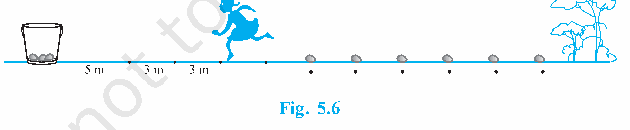
Ten potatoes start 5 m from a bucket and are 3 m apart. Find total out-and-back running distance.
Solution
Board-exam working:
The one-way distances from the bucket are 5,8,11,… with a=5,d=3,n=10.
The last distance is a₁₀=5+(10−1)3=5+27=32 m.
Sum of one-way distances=10/2(5+32)=5×37=185 m.
Each potato requires an outward and return journey, so total distance=2×185=370 m.
Final answer
370 m.