Mathematics · Probability · NCERT Examples
Example 13
A complete, independently verified solution for NCERT Example 13.
Mathematics · Chapter 14 · NCERT Examples
Verified NCERT questions and solutionsSolutions are checked independently and follow the supplied NCERT chapter edition.
NCERT Example
Example 13
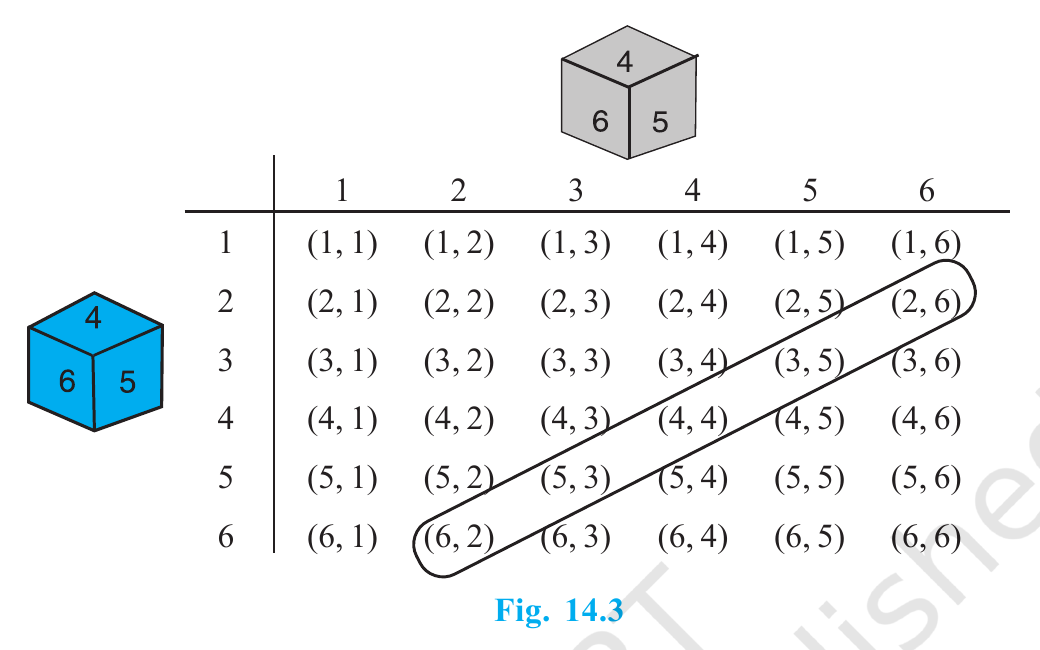
A blue die and a grey die are thrown together. Write all possible outcomes and find the probability that the sum of the top numbers is (i) 8, (ii) 13 and (iii) less than or equal to 12.
Solution
Board-exam working:
The ordered pair records (blue die, grey die). The 6 × 6 table gives 36 equally likely outcomes.
(i) Outcomes whose sum is 8:
(ii) The largest possible sum is 12, so a sum of 13 is impossible.
(iii) Every outcome has sum at most 12.