Mathematics · Probability
NCERT Examples
All 13 worked examples from Probability, with independently verified solutions and direct navigation.
Mathematics · Chapter 14 · NCERT Examples
NCERT Example
Example 1
Find the probability of getting a head when a fair coin is tossed once. Also find the probability of getting a tail.
Solution
Board-exam working:
The equally likely outcomes are Head (H) and Tail (T).
For the event of getting a head, there is one favourable outcome.
For the event of getting a tail, there is also one favourable outcome.
Final answer
NCERT Example
Example 2
A bag contains one red ball, one blue ball and one yellow ball, all of the same size. Kritika draws one ball without looking. Find the probability of drawing (i) the yellow ball, (ii) the red ball and (iii) the blue ball.
Solution
Board-exam working:
The three balls are equally likely to be selected.
Each required event has exactly one favourable outcome.
Final answer
NCERT Example
Example 3
A fair die is thrown once. Find the probability of getting (i) a number greater than 4 and (ii) a number less than or equal to 4.
Solution
Board-exam working:
(i) Numbers greater than 4 are 5 and 6.
(ii) Numbers less than or equal to 4 are 1, 2, 3 and 4.
Final answer
NCERT Example
Example 4
One card is drawn from a well-shuffled deck of 52 cards. Find the probability that it will (i) be an ace and (ii) not be an ace.
Solution
Board-exam working:
A deck has 52 cards and 4 aces.
(i) Number of favourable outcomes for drawing an ace = 4.
(ii) Number of cards that are not aces:
Check using complementary events:
Final answer
NCERT Example
Example 5
Sangeeta and Reshma play a tennis match. The probability that Sangeeta wins is 0.62. Find the probability that Reshma wins.
Solution
Board-exam working:
Exactly one of the two players wins, so their winning events are complementary.
Final answer
NCERT Example
Example 6
Savita and Hamida are friends. Ignoring a leap year, find the probability that both have (i) different birthdays and (ii) the same birthday.
Solution
Board-exam working:
Fix Savita's birthday. Hamida's birthday can be any one of 365 equally likely days.
(i) To have a different birthday, Hamida can be born on any of the other days.
(ii) The same-birthday event is the complement of the different-birthday event.
Final answer
NCERT Example
Example 7
A class has 40 students: 25 girls and 15 boys. One student's name card is drawn at random. Find the probability that the selected name is (i) a girl's and (ii) a boy's.
Solution
Board-exam working:
(i) There are 25 favourable cards bearing girls' names.
(ii) There are 15 favourable cards bearing boys' names.
The probabilities add to 1, as expected.
Final answer
NCERT Example
Example 8
A box contains 3 blue, 2 white and 4 red marbles. One marble is drawn at random. Find the probability that it is (i) white, (ii) blue and (iii) red.
Solution
Board-exam working:
Total number of marbles:
(i) There are 2 white marbles.
(ii) There are 3 blue marbles.
(iii) There are 4 red marbles.
Final answer
NCERT Example
Example 9
Harpreet tosses two different coins simultaneously. Find the probability that she gets at least one head.
Solution
Board-exam working:
Write H for head and T for tail. Because the coins are different, HT and TH are distinct outcomes.
The outcomes containing at least one head are HH, HT and TH.
The same result follows by subtracting the probability of no head.
Final answer
NCERT Example
Example 10
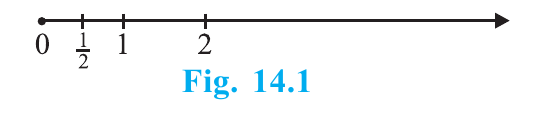
In a musical-chair game, the music may stop at any time within 2 minutes after it begins. Find the probability that it stops within the first half-minute.
NCERT marks this example as not from the examination point of view.
Solution
Board-exam working:
All stopping times from 0 to 2 minutes are equally likely along the interval.
Final answer
NCERT Example
Example 11
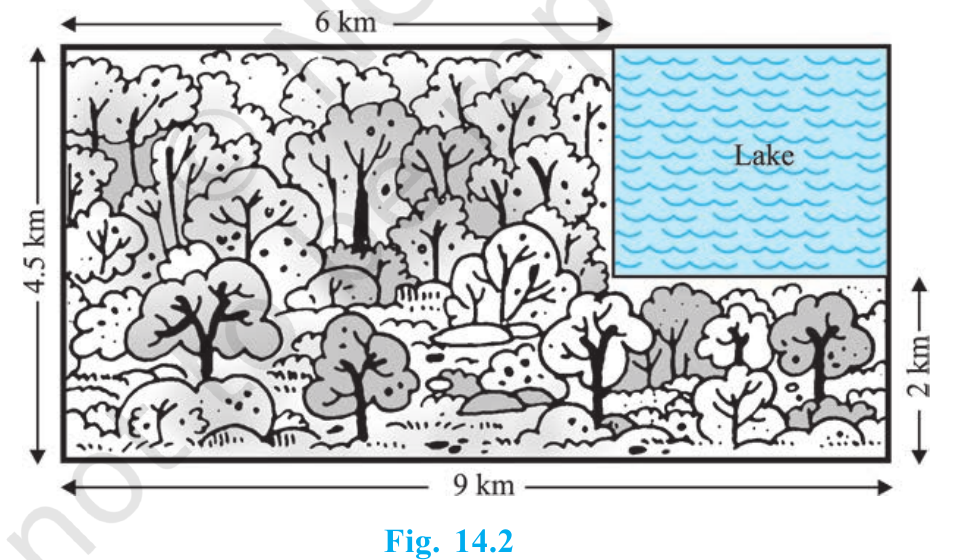
A missing helicopter is equally likely to have crashed anywhere in the rectangular region shown. Find the probability that it crashed inside the lake.
NCERT marks this example as not from the examination point of view.
Solution
Board-exam working:
Area of the complete search region:
From the labelled dimensions, the lake is 3 km wide and 2.5 km high.
Final answer
NCERT Example
Example 12
A carton has 100 shirts: 88 good, 8 with minor defects and 4 with major defects. Jimmy accepts only good shirts; Sujatha rejects only shirts with major defects. One shirt is drawn at random. Find the probability that it is acceptable to (i) Jimmy and (ii) Sujatha.
Solution
Board-exam working:
(i) Jimmy accepts only the 88 good shirts.
(ii) Sujatha accepts good shirts and shirts with minor defects.
Final answer
NCERT Example
Example 13
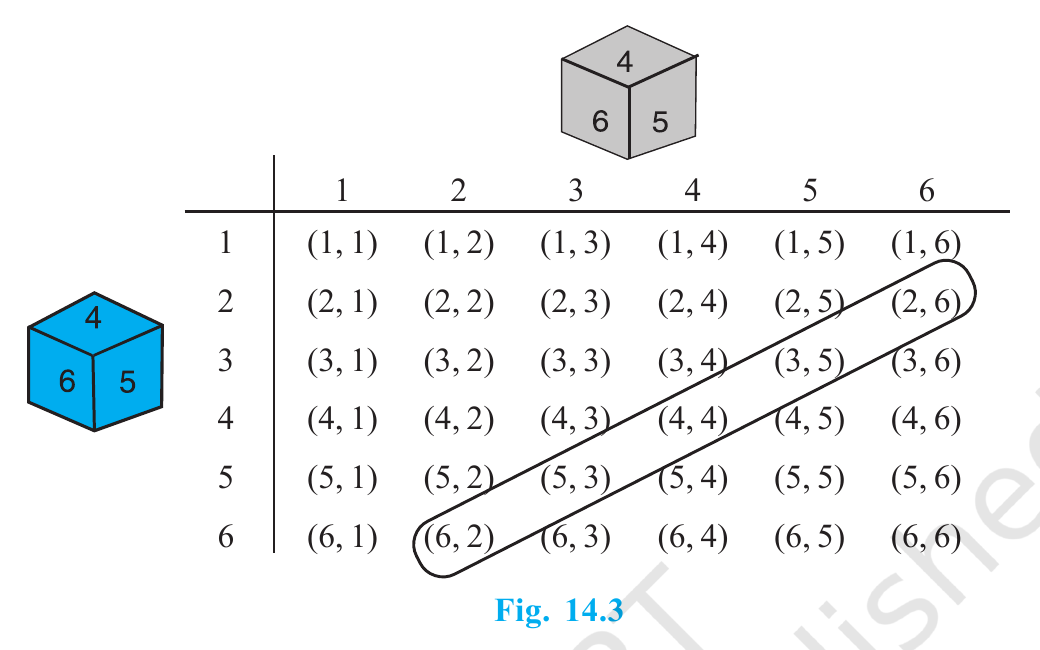
A blue die and a grey die are thrown together. Write all possible outcomes and find the probability that the sum of the top numbers is (i) 8, (ii) 13 and (iii) less than or equal to 12.
Solution
Board-exam working:
The ordered pair records (blue die, grey die). The 6 × 6 table gives 36 equally likely outcomes.
(i) Outcomes whose sum is 8:
(ii) The largest possible sum is 12, so a sum of 13 is impossible.
(iii) Every outcome has sum at most 12.