Padhona

Mathematics · Surface Areas and Volumes · NCERT Exercises

Exercise 12.2

Complete, independently verified solutions for NCERT Exercise 12.2.

Mathematics · Chapter 12 · NCERT Exercises

Verified NCERT questions and solutionsSolutions are checked independently and follow the supplied NCERT chapter edition.

Jump navigator

Choose a question

Question

Question 1

A solid is a cone standing on a hemisphere. Both radii are 1 cm and the cone's height equals its radius. Find the volume in terms of π.

Solution

Board-exam working:

r=1 cm,h=1 cmr=1\text{ cm},\qquad h=1\text{ cm}
V=13πr2h+23πr3V=\frac13\pi r^2h+\frac23\pi r^3
=13π(1)2(1)+23π(1)3=\frac13\pi(1)^2(1)+\frac23\pi(1)^3
=(13+23)π=π cm3=\left(\frac13+\frac23\right)\pi=\pi\text{ cm}^3

Final answer

π cm3\boxed{\pi\text{ cm}^3}

Question

Question 2

A model is a cylinder with a cone attached at each end. Its diameter is 3 cm and total length is 12 cm. Each cone is 2 cm high. Find the volume of air contained in the model.

Solution

Board-exam working:

r=32=1.5 cmr=\frac32=1.5\text{ cm}

Length of the cylindrical part:

hc=1222=8 cmh_c=12-2-2=8\text{ cm}

Total volume = cylinder + two cones.

V=πr2hc+2(13πr2hcone)V=\pi r^2h_c+2\left(\frac13\pi r^2h_{cone}\right)
=π(1.5)2(8)+2[13π(1.5)2(2)]=\pi(1.5)^2(8)+2\left[\frac13\pi(1.5)^2(2)\right]
=18π+3π=21π cm3=18\pi+3\pi=21\pi\text{ cm}^3
=21×227=66 cm3=21\times\frac{22}{7}=66\text{ cm}^3

Final answer

66 cm3\boxed{66\text{ cm}^3}

Question

Question 3

A gulab jamun contains sugar syrup equal to about 30% of its volume. Find approximately how much syrup is present in 45 gulab jamuns, each shaped like a cylinder with two hemispherical ends, length 5 cm and diameter 2.8 cm.
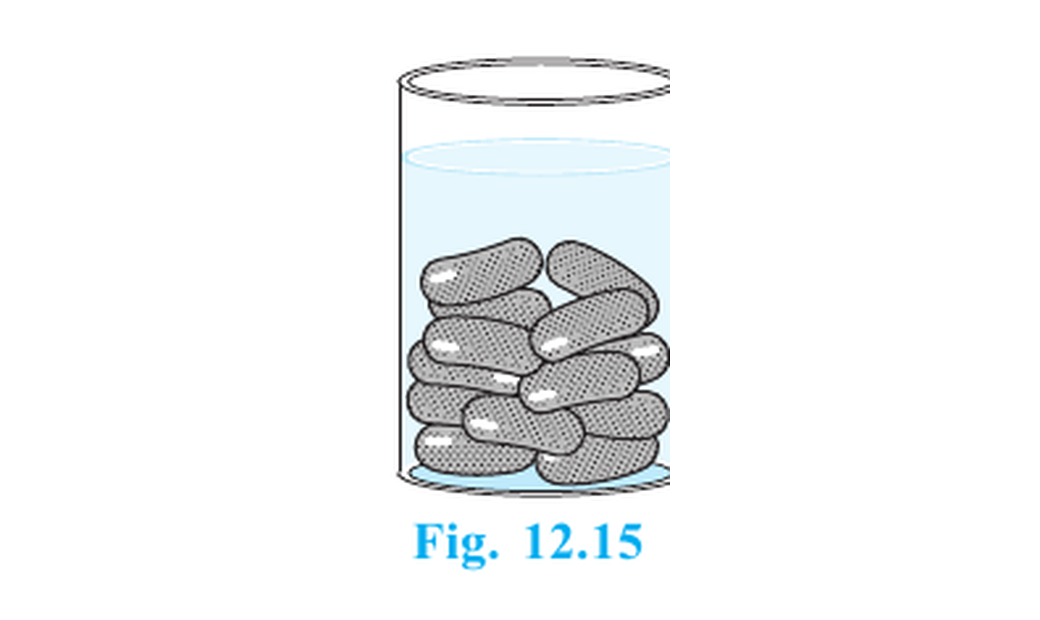
Gulab jamuns shaped as cylinders with hemispherical ends inside a glass jar.
Figure 12-15 from the supplied NCERT chapter.

Solution

Board-exam working:

r=2.82=1.4 cmr=\frac{2.8}{2}=1.4\text{ cm}

The two hemispherical ends form a sphere of total length 2r. Therefore, cylinder length:

h=52(1.4)=2.2 cmh=5-2(1.4)=2.2\text{ cm}

Volume of one gulab jamun:

V=πr2h+43πr3V=\pi r^2h+\frac43\pi r^3
=227(1.4)2(2.2)+43×227(1.4)3=\frac{22}{7}(1.4)^2(2.2)+\frac43\times\frac{22}{7}(1.4)^3
25.05 cm3\approx25.05\text{ cm}^3

Syrup in 45 pieces at 30%:

Vs=45×30100×25.05V_s=45\times\frac{30}{100}\times25.05
338.18 cm3338 cm3\approx338.18\text{ cm}^3\approx338\text{ cm}^3

Final answer

338 cm3 (approximately)\boxed{338\text{ cm}^3\text{ (approximately)}}

Question

Question 4

A wooden pen stand is a cuboid measuring 15 cm × 10 cm × 3.5 cm with four conical depressions. Each depression has radius 0.5 cm and depth 1.4 cm. Find the volume of wood in the stand.
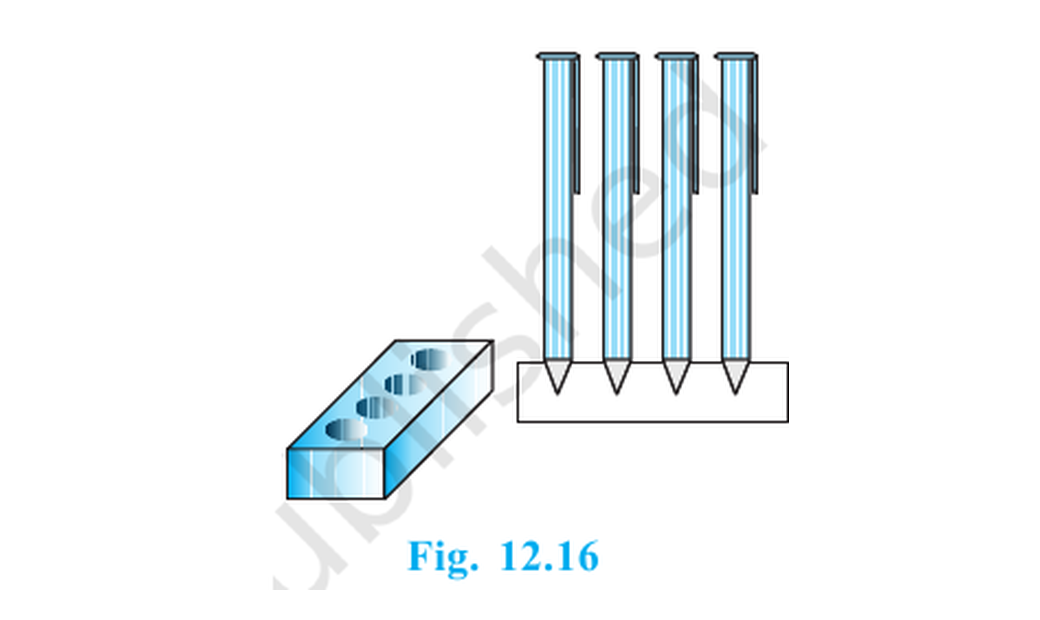
Wooden pen stand with four conical depressions, shown with four pens.
Figure 12-16 from the supplied NCERT chapter.

Solution

Board-exam working:

Volume of the cuboid:

Vc=15×10×3.5=525 cm3V_c=15\times10\times3.5=525\text{ cm}^3

Volume of one conical depression:

V1=13πr2hV_1=\frac13\pi r^2h
=13×227×(0.5)2×1.4=\frac13\times\frac{22}{7}\times(0.5)^2\times1.4
=1130 cm3=\frac{11}{30}\text{ cm}^3

Volume removed by four depressions:

4V1=4×1130=2215 cm34V_1=4\times\frac{11}{30}=\frac{22}{15}\text{ cm}^3

Volume of wood:

V=5252215=523.533 cm3V=525-\frac{22}{15}=523.533\ldots\text{ cm}^3
V523.53 cm3V\approx523.53\text{ cm}^3

Final answer

523.53 cm3 (approximately)\boxed{523.53\text{ cm}^3\text{ (approximately)}}

Question

Question 5

An inverted conical vessel has height 8 cm and open-top radius 5 cm. It is full of water. Spherical lead shots of radius 0.5 cm are dropped in, causing one-fourth of the water to flow out. Find the number of shots.

Solution

Board-exam working:

Volume of water initially in the cone:

V=13πr2h=13π(5)2(8)=200π3 cm3V=\frac13\pi r^2h=\frac13\pi(5)^2(8)=\frac{200\pi}{3}\text{ cm}^3

One-fourth flows out, so displaced volume:

Vd=14×200π3=50π3 cm3V_d=\frac14\times\frac{200\pi}{3}=\frac{50\pi}{3}\text{ cm}^3

Volume of one spherical shot:

Vs=43π(0.5)3=π6 cm3V_s=\frac43\pi(0.5)^3=\frac{\pi}{6}\text{ cm}^3

If n shots are dropped:

n×π6=50π3n\times\frac{\pi}{6}=\frac{50\pi}{3}
n=50π3×6π=100n=\frac{50\pi}{3}\times\frac6\pi=100

Final answer

100 lead shots\boxed{100\text{ lead shots}}

Question

Question 6

A solid iron pole consists of a cylinder of height 220 cm and base diameter 24 cm surmounted by another cylinder of height 60 cm and radius 8 cm. Find its mass if 1 cm³ of iron has mass approximately 8 g. Use π = 3.14.

Solution

Board-exam working:

Lower cylinder:

r1=12 cm,h1=220 cmr_1=12\text{ cm},\qquad h_1=220\text{ cm}

Upper cylinder:

r2=8 cm,h2=60 cmr_2=8\text{ cm},\qquad h_2=60\text{ cm}

Total volume:

V=πr12h1+πr22h2V=\pi r_1^2h_1+\pi r_2^2h_2
=3.14[(12)2(220)+(8)2(60)]=3.14[(12)^2(220)+(8)^2(60)]
=3.14[31680+3840]=111532.8 cm3=3.14[31680+3840]=111532.8\text{ cm}^3

Mass in grams:

M=111532.8×8=892262.4 gM=111532.8\times8=892262.4\text{ g}

Convert to kilograms:

M=892262.41000=892.2624 kgM=\frac{892262.4}{1000}=892.2624\text{ kg}

Final answer

892.2624 kg (approximately)\boxed{892.2624\text{ kg (approximately)}}

Question

Question 7

A cone of height 120 cm and radius 60 cm stands on a hemisphere of radius 60 cm inside an upright cylinder full of water. The cylinder has radius 60 cm and height 180 cm. Find the volume of water left.

Solution

Board-exam working:

Volume of the cylinder:

Vc=πr2h=π(60)2(180)=648000π cm3V_c=\pi r^2h=\pi(60)^2(180)=648000\pi\text{ cm}^3

Volume of the cone:

Vcone=13π(60)2(120)=144000π cm3V_{cone}=\frac13\pi(60)^2(120)=144000\pi\text{ cm}^3

Volume of the hemisphere:

Vh=23π(60)3=144000π cm3V_h=\frac23\pi(60)^3=144000\pi\text{ cm}^3

Volume of the inserted solid:

Vs=144000π+144000π=288000π cm3V_s=144000\pi+144000\pi=288000\pi\text{ cm}^3

Water left:

Vw=648000π288000π=360000π cm3V_w=648000\pi-288000\pi=360000\pi\text{ cm}^3
=360000×2271131428.57 cm3=360000\times\frac{22}{7}\approx1131428.57\text{ cm}^3

Final answer

360000π cm31131428.57 cm3\boxed{360000\pi\text{ cm}^3\approx1131428.57\text{ cm}^3}

Question

Question 8

A spherical glass vessel has a cylindrical neck 8 cm long and 2 cm in diameter. The spherical part has diameter 8.5 cm. A child measures its capacity as 345 cm³. Check whether she is correct, using the inside measurements and π = 3.14.

Solution

Board-exam working:

Spherical part:

R=8.52=4.25 cmR=\frac{8.5}{2}=4.25\text{ cm}

Cylindrical neck:

r=22=1 cm,h=8 cmr=\frac22=1\text{ cm},\qquad h=8\text{ cm}

Calculated vessel volume:

V=43πR3+πr2hV=\frac43\pi R^3+\pi r^2h
=43(3.14)(4.25)3+3.14(1)2(8)=\frac43(3.14)(4.25)^3+3.14(1)^2(8)
=321.392+25.12=321.392\ldots+25.12
346.51 cm3\approx346.51\text{ cm}^3

The measured value 345 cm³ is not equal to the calculated capacity of about 346.51 cm³.

Final answer

No. The calculated capacity is approximately 346.51 cm³, not 345 cm³.