Mathematics · Surface Areas and Volumes · NCERT Exercises
Exercise 12.1
Complete, independently verified solutions for NCERT Exercise 12.1.
Mathematics · Chapter 12 · NCERT Exercises
Question
Question 1
Two cubes, each of volume 64 cm³, are joined end to end. Find the surface area of the resulting cuboid.
Solution
Board-exam working:
Let a be the edge of each cube.
Joining the cubes end to end gives a cuboid of dimensions 8 cm × 4 cm × 4 cm.
Final answer
Question
Question 2
A vessel is a hollow hemisphere mounted by a hollow cylinder. The hemisphere's diameter is 14 cm and the vessel's total height is 13 cm. Find its inner surface area.
Solution
Board-exam working:
Cylinder height:
The open vessel's inner area is the curved area of the cylinder plus that of the hemisphere.
Final answer
Question
Question 3
A toy is a cone of radius 3.5 cm mounted on a hemisphere of the same radius. Its total height is 15.5 cm. Find its total surface area.
Solution
Board-exam working:
Cone height:
Slant height:
Only the curved surfaces are exposed.
Final answer
Question
Question 4
A cubical block of side 7 cm is surmounted by a hemisphere. What is the greatest diameter the hemisphere can have? Find the surface area of the solid.
Solution
Board-exam working:
The hemisphere's base must fit within the square top face, so its greatest diameter equals the cube's side.
Surface area = cube TSA − covered circular area + hemisphere CSA.
Final answer
Question
Question 5
A hemispherical depression is cut from one face of a cubical block so that the hemisphere's diameter l equals the cube's edge. Determine the surface area of the remaining solid.
Solution
Board-exam working:
Start with the surface area of the cube, remove the circular opening and add the curved area of the depression.
Final answer
Question
Question 6
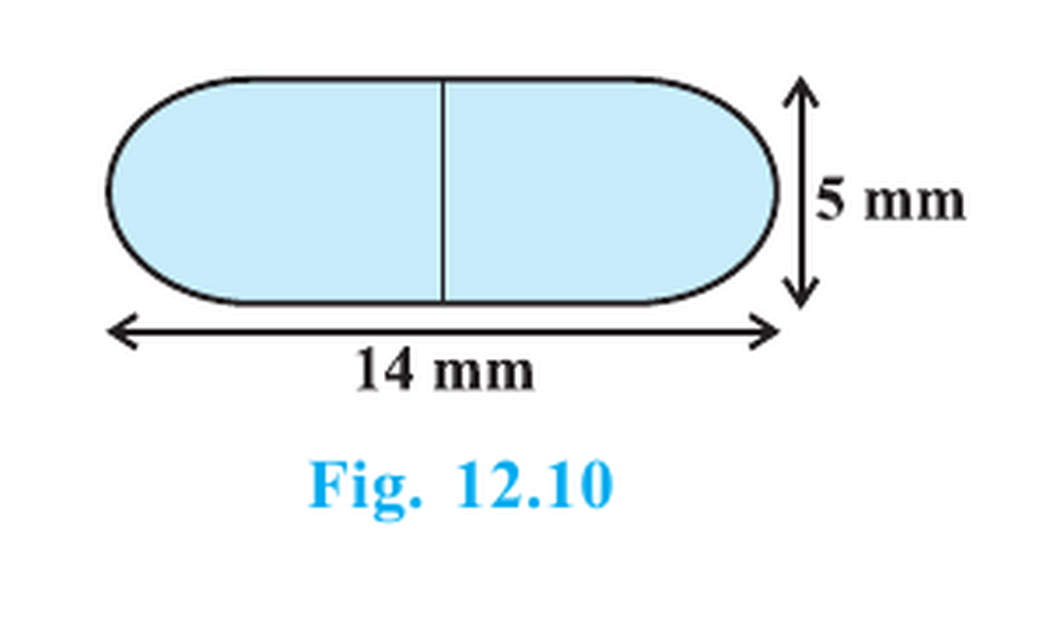
A medicine capsule is a cylinder with two hemispheres at its ends. Its total length is 14 mm and its diameter is 5 mm. Find its surface area.
Solution
Board-exam working:
The two hemispherical ends together have length equal to the diameter, so the cylindrical length is:
Surface area = cylinder CSA + surface area of a sphere.
Final answer
Question
Question 7
A tent is a cylinder surmounted by a cone. The cylindrical part is 2.1 m high and 4 m in diameter; the conical top has slant height 2.8 m. Find the canvas area and its cost at ₹500 per m². The base is not covered.
Solution
Board-exam working:
Canvas area = cylinder CSA + cone CSA.
Cost:
Final answer
Canvas area = 44 m²; cost = ₹22,000.
Question
Question 8
A conical cavity of height 2.4 cm and diameter 1.4 cm is hollowed from a solid cylinder with the same height and diameter. Find the total surface area of the remaining solid to the nearest cm².
Solution
Board-exam working:
Slant height of the conical cavity:
Remaining surface = outer cylinder CSA + bottom base + inner cone CSA.
Final answer
Question
Question 9
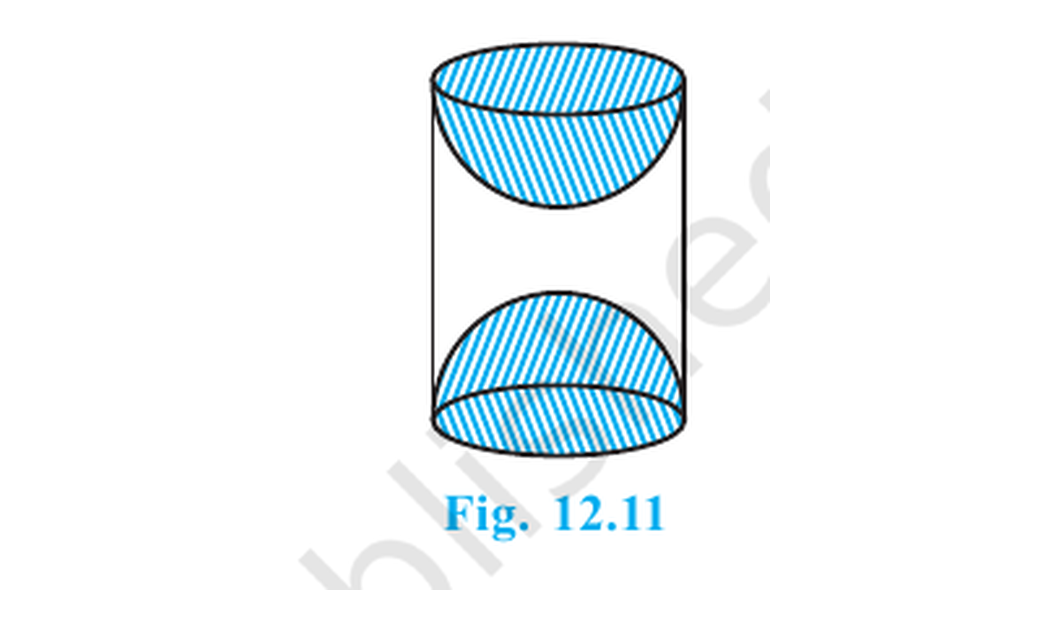
A wooden article is made by scooping a hemisphere from each end of a solid cylinder. The cylinder is 10 cm high and has radius 3.5 cm. Find the article's total surface area.
Solution
Board-exam working:
The exposed surface is the cylinder's curved surface plus the curved surfaces of two hemispherical cavities.