Mathematics · Some Applications of Trigonometry · NCERT Exercises
Exercise 9.1
Complete, independently verified solutions for NCERT Exercise 9.1.
Mathematics · Chapter 9 · NCERT Exercises
Question
Question 1
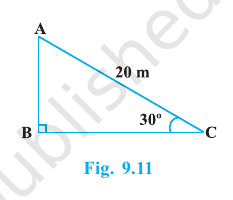
A circus artist is climbing a 20 m long rope, tightly stretched and tied from the top of a vertical pole to the ground. Find the height of the pole if the rope makes an angle of 30° with the ground.
Solution
Board-exam working:
In right triangle ABC, AC = 20 m and ∠ACB = 30°.
Final answer
The pole is 10 m high.
Question
Question 2
A tree breaks due to a storm and the broken part bends so that its top touches the ground, making an angle of 30° with it. The distance from the foot of the tree to the point where the top touches the ground is 8 m. Find the original height of the tree.
Solution
Board-exam working:
Let AB be the remaining upright part, AC the broken part and BC = 8 m.
Final answer
The original height of the tree was 8√3 m.
Question
Question 3
A contractor plans two slides. One has a height of 1.5 m and is inclined at 30° to the ground; the other has a height of 3 m and is inclined at 60°. Find the length of each slide.
Solution
Board-exam working:
(i) Slide for younger children:
(ii) Slide for older children:
Final answer
The slide lengths are 3 m and 2√3 m.
Question
Question 4
The angle of elevation of the top of a tower from a point 30 m away from its foot is 30°. Find the height of the tower.
Solution
Board-exam working:
Let h be the height of the tower.
Final answer
The tower is 10√3 m high.
Question
Question 5
A kite is flying at a height of 60 m above the ground. Its string is inclined at 60° to the ground. Find the length of the string, assuming there is no slack.
Solution
Board-exam working:
Let L be the string length.
Final answer
The string is 40√3 m long.
Question
Question 6
A 1.5 m tall boy stands at some distance from a 30 m building. The angle of elevation from his eyes to the top increases from 30° to 60° as he walks towards the building. Find the distance he walked.
Solution
Board-exam working:
Height of the building above the boy's eyes:
Let the initial distance be x m.
Let the final distance be y m.
Final answer
The boy walked 19√3 m.
Question
Question 7
From a point on the ground, the angles of elevation of the bottom and top of a transmission tower fixed on a 20 m high building are 45° and 60°, respectively. Find the height of the tower.
Solution
Board-exam working:
Let x be the horizontal distance and h be the transmission tower height.
Using the bottom of the tower:
Using the top of the tower:
Final answer
The transmission tower is 20(√3 − 1) m high.
Question
Question 8
A statue 1.6 m tall stands on a pedestal. From a point on the ground, the angle of elevation of the top of the statue is 60° and that of the top of the pedestal is 45°. Find the height of the pedestal.
Solution
Board-exam working:
Let the pedestal height be h m and the horizontal distance be x m.
Using the top of the statue:
Final answer
The pedestal is 0.8(√3 + 1) m high.
Question
Question 9
The angle of elevation of the top of a building from the foot of a tower is 30°, and the angle of elevation of the top of the tower from the foot of the building is 60°. If the tower is 50 m high, find the height of the building.
Solution
Board-exam working:
Let the distance between the building and tower be x m and the building height be h m.
Using the 50 m tower:
Using the building:
Final answer
The building is 50/3 m high.
Question
Question 10
Two poles of equal heights stand opposite each other on either side of an 80 m wide road. From a point between them, the angles of elevation of their tops are 60° and 30°. Find the height of the poles and the distances of the point from them.
Solution
Board-exam working:
Let the pole height be h m and the distance from the pole seen at 60° be x m. The other distance is 80 − x.
Substitute h = x√3 in (2):
Final answer
Each pole is 20√3 m high; the point is 20 m and 60 m from the poles.
Question
Question 11
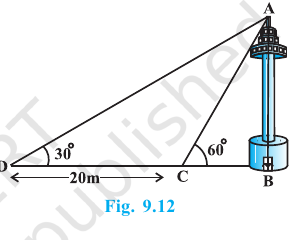
A TV tower stands vertically on a bank of a canal. From a point on the opposite bank directly opposite the tower, the angle of elevation is 60°. From another point 20 m farther away on the same line, the angle is 30°. Find the height of the tower and the width of the canal.
Solution
Board-exam working:
Let the canal width BC = x m and the tower height AB = h m. Then DB = x + 20 m.
From point C:
From point D:
Substitute (1) in (2):
Final answer
The canal is 10 m wide and the tower is 10√3 m high.
Question
Question 12
From the top of a 7 m high building, the angle of elevation of the top of a cable tower is 60° and the angle of depression of its foot is 45°. Find the height of the tower.
Solution
Board-exam working:
Let x be the horizontal distance. The observer is 7 m above ground.
Let h be the part of the tower above the observer's level.
Final answer
The cable tower is 7(1 + √3) m high.
Question
Question 13
From the top of a 75 m lighthouse, the angles of depression of two ships on the same side are 30° and 45°. One ship is exactly behind the other. Find the distance between the ships.
Solution
Board-exam working:
Let the nearer ship be x m from the lighthouse and the farther ship be y m away.
For the nearer ship:
For the farther ship:
Final answer
The ships are 75(√3 − 1) m apart.
Question
Question 14
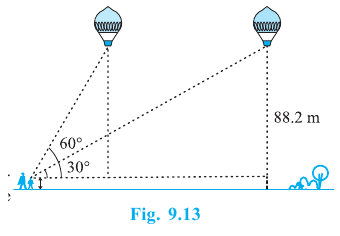
A 1.2 m tall girl spots a balloon moving horizontally at a height of 88.2 m. The angle of elevation from her eyes is initially 60° and later becomes 30°. Find the distance travelled by the balloon.
Solution
Board-exam working:
Vertical height of the balloon above the girl's eyes:
Let the initial horizontal distance be x m.
Let the later horizontal distance be y m.
Final answer
The balloon travelled 58√3 m.
Question
Question 15
A straight highway leads to the foot of a tower. A man at the top observes a car approaching at an angle of depression of 30°. Six seconds later, the angle of depression is 60°. Find the time the car will take to reach the tower from this second point, assuming uniform speed.
Solution
Board-exam working:
Let the tower height be h m. Let the car's initial and later distances from the tower be x m and y m.
At the first position:
At the second position:
Distance travelled in 6 seconds:
The remaining distance is:
This is half the distance travelled in 6 seconds. At uniform speed, the time is also half.
Final answer
The car will reach the tower in 3 seconds.