Mathematics · Some Applications of Trigonometry
NCERT Examples
All 7 worked examples from Some Applications of Trigonometry, with independently verified solutions and direct navigation.
Mathematics · Chapter 9 · NCERT Examples
NCERT Example
Example 1
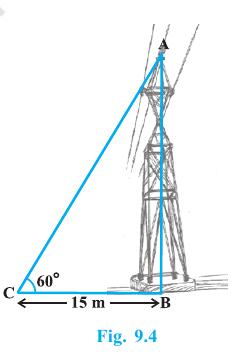
A tower stands vertically on the ground. From a point 15 m away from the foot of the tower, the angle of elevation of its top is 60°. Find the height of the tower.
Solution
Board-exam working:
Let AB be the height of the tower and BC = 15 m.
Final answer
The height of the tower is 15√3 m.
NCERT Example
Example 2
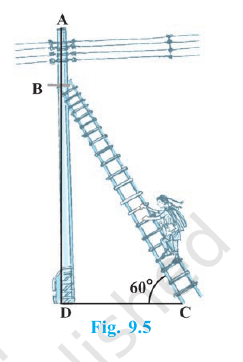
An electrician has to repair an electric fault on a pole of height 5 m. She needs to reach a point 1.3 m below the top. What length of ladder, inclined at 60° to the horizontal, is required? How far from the foot of the pole should the ladder be placed? Take √3 = 1.73.
Solution
Board-exam working:
The height reached on the pole is:
Let BC be the ladder.
Let DC be the distance of the ladder from the pole.
Final answer
Required ladder length ≈ 4.28 m; distance from the pole ≈ 2.14 m.
NCERT Example
Example 3
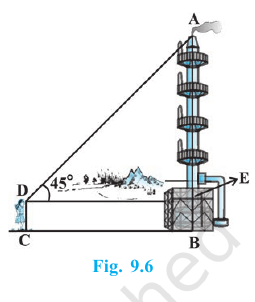
An observer 1.5 m tall is 28.5 m away from a chimney. The angle of elevation of the top of the chimney from her eyes is 45°. Find the height of the chimney.
Solution
Board-exam working:
Let AE be the part of the chimney above the observer's eye level.
Final answer
The chimney is 30 m high.
NCERT Example
Example 4
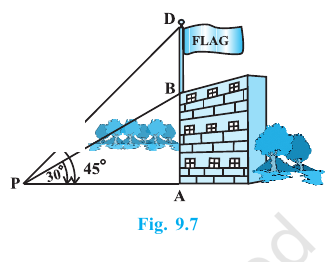
From a point P on the ground, the angle of elevation of the top of a 10 m building is 30°. A flag is hoisted at the top and the angle of elevation of the top of the flagstaff is 45°. Find the flagstaff length and the distance of the building from P. Take √3 = 1.732.
Solution
Board-exam working:
Let PA be the distance from P to the building.
Let DB = x m be the flagstaff length. Then AD = 10 + x.
Final answer
The flagstaff is 7.32 m long and the building is 17.32 m from P.
NCERT Example
Example 5
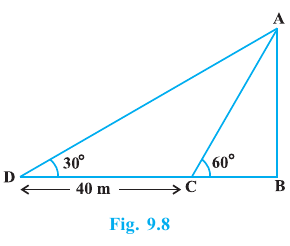
The shadow of a tower is 40 m longer when the Sun's altitude is 30° than when it is 60°. Find the height of the tower.
Solution
Board-exam working:
Let AB = h m and BC = x m. Then BD = x + 40 m.
Using triangle ABC:
Using triangle ABD:
Equating (1) and (2):
Final answer
The height of the tower is 20√3 m.
NCERT Example
Example 6
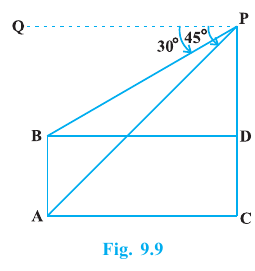
The angles of depression of the top and bottom of an 8 m building from the top of a multi-storeyed building are 30° and 45°, respectively. Find the height of the multi-storeyed building and the distance between the buildings.
Solution
Board-exam working:
Let PD = x m. Since AB = DC = 8 m, the total height PC = x + 8 m.
In triangle PBD:
In triangle PAC:
The distance between the buildings is the same, so AC = BD.
Final answer
Height of the multi-storeyed building = 4(√3 + 3) m; distance between the buildings = 4(√3 + 3) m.
NCERT Example
Example 7
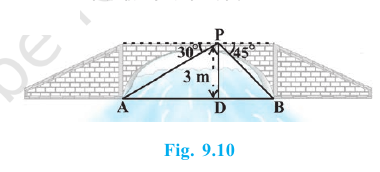
From a point on a bridge across a river, the angles of depression of the opposite banks are 30° and 45°. If the bridge is 3 m above the banks, find the width of the river.
Solution
Board-exam working:
Let P be the observation point and PD = 3 m. The river width is AB = AD + DB.
In triangle APD:
In triangle PBD:
Final answer
The river is 3(√3 + 1) m wide.