Padhona

Mathematics · Introduction to Trigonometry · NCERT Exercises

Exercise 8.1

Complete, independently verified solutions for NCERT Exercise 8.1.

Mathematics · Chapter 8 · NCERT Exercises

Verified NCERT questions and solutionsSolutions are checked independently and follow the supplied NCERT chapter edition.

Jump navigator

Choose a question

Question

Question 1

In right triangle ABC, right-angled at B, AB = 24 cm and BC = 7 cm. Find (i) sin A, cos A and (ii) sin C, cos C.

Solution

Board-exam working:

AC=AB2+BC2=242+72=25 cmAC=\sqrt{AB^2+BC^2}=\sqrt{24^2+7^2}=25\text{ cm}

(i) For angle A:

sinA=BCAC=725\sin A=\frac{BC}{AC}=\frac7{25}
cosA=ABAC=2425\cos A=\frac{AB}{AC}=\frac{24}{25}

(ii) For angle C:

sinC=ABAC=2425\sin C=\frac{AB}{AC}=\frac{24}{25}
cosC=BCAC=725\cos C=\frac{BC}{AC}=\frac7{25}

Final answer

(i) sinA=725, cosA=2425;(ii) sinC=2425, cosC=725\text{(i) }\sin A=\frac7{25},\ \cos A=\frac{24}{25};\qquad \text{(ii) }\sin C=\frac{24}{25},\ \cos C=\frac7{25}

Question

Question 2

In Figure 8.13, find tan P − cot R.
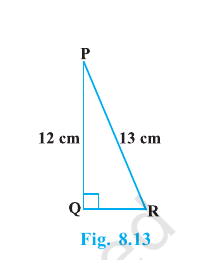
Right triangle PQR, right-angled at Q, with PQ 12 centimetres and PR 13 centimetres.
Figure 8-13 from the supplied NCERT chapter.

Solution

Board-exam working:

QR=PR2PQ2=132122=5 cmQR=\sqrt{PR^2-PQ^2}=\sqrt{13^2-12^2}=5\text{ cm}
tanP=QRPQ=512\tan P=\frac{QR}{PQ}=\frac5{12}
cotR=QRPQ=512\cot R=\frac{QR}{PQ}=\frac5{12}
tanPcotR=512512=0\tan P-\cot R=\frac5{12}-\frac5{12}=0

Final answer

0

Question

Question 3

If sin A = 3/4, calculate cos A and tan A.

Solution

Board-exam working:

sinA=oppositehypotenuse=34\sin A=\frac{\text{opposite}}{\text{hypotenuse}}=\frac34

Let opposite side = 3k and hypotenuse = 4k.

adjacent side=(4k)2(3k)2=k7\text{adjacent side}=\sqrt{(4k)^2-(3k)^2}=k\sqrt7
cosA=74\cos A=\frac{\sqrt7}{4}
tanA=37=377\tan A=\frac3{\sqrt7}=\frac{3\sqrt7}{7}

Final answer

cosA=74,tanA=377\cos A=\frac{\sqrt7}{4},\qquad \tan A=\frac{3\sqrt7}{7}

Question

Question 4

Given 15 cot A = 8, find sin A and sec A.

Solution

Board-exam working:

15cotA=8cotA=81515\cot A=8\Rightarrow \cot A=\frac8{15}

Let adjacent side = 8k and opposite side = 15k.

hypotenuse=(8k)2+(15k)2=17k\text{hypotenuse}=\sqrt{(8k)^2+(15k)^2}=17k
sinA=15k17k=1517\sin A=\frac{15k}{17k}=\frac{15}{17}
secA=17k8k=178\sec A=\frac{17k}{8k}=\frac{17}{8}

Final answer

sinA=1517,secA=178\sin A=\frac{15}{17},\qquad \sec A=\frac{17}{8}

Question

Question 5

Given sec θ = 13/12, calculate all other trigonometric ratios.

Solution

Board-exam working:

secθ=hypotenuseadjacent=1312\sec\theta=\frac{\text{hypotenuse}}{\text{adjacent}}=\frac{13}{12}

Let hypotenuse = 13k and adjacent side = 12k.

opposite side=(13k)2(12k)2=5k\text{opposite side}=\sqrt{(13k)^2-(12k)^2}=5k
sinθ=513\sin\theta=\frac5{13}
cosθ=1213\cos\theta=\frac{12}{13}
tanθ=512\tan\theta=\frac5{12}
cotθ=125\cot\theta=\frac{12}{5}
cosecθ=135\cosec\theta=\frac{13}{5}

Final answer

sinθ=513, cosθ=1213, tanθ=512, cotθ=125, cosecθ=135\sin\theta=\frac5{13},\ \cos\theta=\frac{12}{13},\ \tan\theta=\frac5{12},\ \cot\theta=\frac{12}{5},\ \cosec\theta=\frac{13}{5}

Question

Question 6

If A and B are acute angles such that cos A = cos B, show that A = B.

Solution

Board-exam working:

For acute angles, cosine has one distinct value for each angle and decreases from 1 to 0 as the angle increases from 0° to 90°.

cosA=cosB\cos A=\cos B

Therefore A and B cannot be different acute angles.

A=B\angle A=\angle B

Final answer

Hence, ∠A = ∠B.

Question

Question 7

If cot θ = 7/8, evaluate (i) [(1 + sin θ)(1 − sin θ)]/[(1 + cos θ)(1 − cos θ)] and (ii) cot²θ.

Solution

Board-exam working:

(i)

(1+sinθ)(1sinθ)(1+cosθ)(1cosθ)=1sin2θ1cos2θ\frac{(1+\sin\theta)(1-\sin\theta)}{(1+\cos\theta)(1-\cos\theta)}=\frac{1-\sin^2\theta}{1-\cos^2\theta}
=cos2θsin2θ=cot2θ=\frac{\cos^2\theta}{\sin^2\theta}=\cot^2\theta
=(78)2=4964=\left(\frac78\right)^2=\frac{49}{64}

(ii)

cot2θ=(78)2=4964\cot^2\theta=\left(\frac78\right)^2=\frac{49}{64}

Final answer

(i) 4964;(ii) 4964\text{(i) }\frac{49}{64};\qquad \text{(ii) }\frac{49}{64}

Question

Question 8

If 3 cot A = 4, check whether (1 − tan²A)/(1 + tan²A) = cos²A − sin²A.

Solution

Board-exam working:

3cotA=4cotA=43tanA=343\cot A=4\Rightarrow \cot A=\frac43\Rightarrow \tan A=\frac34

Left-hand side:

LHS=1(34)21+(34)2=725\mathrm{LHS}=\frac{1-\left(\frac34\right)^2}{1+\left(\frac34\right)^2}=\frac{7}{25}

Using sides 3, 4 and 5:

sinA=35,cosA=45\sin A=\frac35,\qquad \cos A=\frac45

Right-hand side:

RHS=(45)2(35)2=725\mathrm{RHS}=\left(\frac45\right)^2-\left(\frac35\right)^2=\frac7{25}
LHS=RHS\mathrm{LHS}=\mathrm{RHS}

Final answer

Yes, the equality is true.

Question

Question 9

In triangle ABC, right-angled at B, tan A = 1/√3. Find (i) sin A cos C + cos A sin C and (ii) cos A cos C − sin A sin C.

Solution

Board-exam working:

tanA=13A=30\tan A=\frac1{\sqrt3}\Rightarrow A=30^\circ
C=90A=60C=90^\circ-A=60^\circ

(i)

sin30cos60+cos30sin60\sin30^\circ\cos60^\circ+\cos30^\circ\sin60^\circ
=1212+3232=14+34=1=\frac12\cdot\frac12+\frac{\sqrt3}{2}\cdot\frac{\sqrt3}{2}=\frac14+\frac34=1

(ii)

cos30cos60sin30sin60\cos30^\circ\cos60^\circ-\sin30^\circ\sin60^\circ
=32121232=0=\frac{\sqrt3}{2}\cdot\frac12-\frac12\cdot\frac{\sqrt3}{2}=0

Final answer

(i) 1; (ii) 0.

Question

Question 10

In right triangle PQR, right-angled at Q, PR + QR = 25 cm and PQ = 5 cm. Find sin P, cos P and tan P.

Solution

Board-exam working:

Let QR = x cm. Then PR = 25 − x cm.

PR2=PQ2+QR2PR^2=PQ^2+QR^2
(25x)2=52+x2(25-x)^2=5^2+x^2
62550x+x2=25+x2625-50x+x^2=25+x^2
x=12x=12
QR=12 cm,PR=13 cmQR=12\text{ cm},\qquad PR=13\text{ cm}
sinP=1213\sin P=\frac{12}{13}
cosP=513\cos P=\frac5{13}
tanP=125\tan P=\frac{12}{5}

Final answer

sinP=1213,cosP=513,tanP=125\sin P=\frac{12}{13},\qquad \cos P=\frac5{13},\qquad \tan P=\frac{12}{5}

Question

Question 11

State true or false and justify: (i) tan A is always less than 1; (ii) sec A = 12/5 for some angle A; (iii) cos A abbreviates cosecant A; (iv) cot A is the product of cot and A; (v) sin θ = 4/3 for some angle θ.

Solution

Board-exam working:

(i) False.

tan45=1andtan60=3>1\tan45^\circ=1\quad\text{and}\quad\tan60^\circ=\sqrt3>1

(ii) True.

secA=125cosA=512\sec A=\frac{12}{5}\Rightarrow \cos A=\frac5{12}

Since 0 < 5/12 < 1, such an acute angle exists.

(iii) False. cos A means cosine of A; cosecant is written cosec A.

(iv) False. cot A denotes the cotangent ratio of angle A.

(v) False.

0sinθ1,but43>10\leq\sin\theta\leq1,\quad\text{but}\quad\frac43>1

Final answer

(i) False; (ii) True; (iii) False; (iv) False; (v) False.