Padhona

Mathematics · Introduction to Trigonometry

NCERT Examples

All 12 worked examples from Introduction to Trigonometry, with independently verified solutions and direct navigation.

Mathematics · Chapter 8 · NCERT Examples

Verified NCERT questions and solutionsSolutions are checked independently and follow the supplied NCERT chapter edition.

Jump navigator

Choose a example

NCERT Example

Example 1

Given tan A = 4/3, find the other trigonometric ratios of angle A.
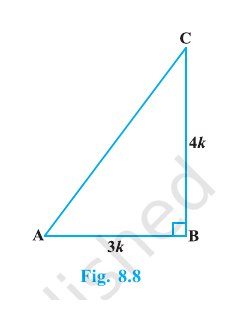
Right triangle ABC, right-angled at B, with AB equal to 3k and BC equal to 4k.
Figure 8-8 from the supplied NCERT chapter.

Solution

Board-exam working:

tanA=BCAB=43\tan A=\frac{BC}{AB}=\frac43

Let BC = 4k and AB = 3k.

AC=AB2+BC2=(3k)2+(4k)2=5kAC=\sqrt{AB^2+BC^2}=\sqrt{(3k)^2+(4k)^2}=5k
sinA=BCAC=45\sin A=\frac{BC}{AC}=\frac45
cosA=ABAC=35\cos A=\frac{AB}{AC}=\frac35
cotA=34\cot A=\frac34
cosecA=54\cosec A=\frac54
secA=53\sec A=\frac53

Final answer

sinA=45, cosA=35, cotA=34, cosecA=54, secA=53\sin A=\frac45,\ \cos A=\frac35,\ \cot A=\frac34,\ \cosec A=\frac54,\ \sec A=\frac53

NCERT Example

Example 2

If B and Q are acute angles such that sin B = sin Q, prove that B = Q.
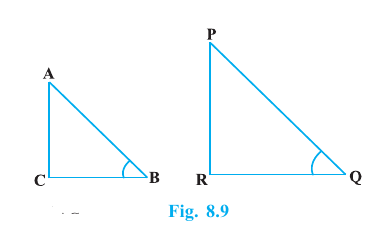
Two right triangles ABC and PQR with equal acute angles B and Q marked for comparison.
Figure 8-9 from the supplied NCERT chapter.

Solution

Board-exam working:

Consider right triangles ABC and PQR as shown.

sinB=ACAB,sinQ=PRPQ\sin B=\frac{AC}{AB},\qquad \sin Q=\frac{PR}{PQ}
ACAB=PRPQ\frac{AC}{AB}=\frac{PR}{PQ}
ACPR=ABPQ=k\frac{AC}{PR}=\frac{AB}{PQ}=k

By the Pythagoras theorem:

BC=AB2AC2,QR=PQ2PR2BC=\sqrt{AB^2-AC^2},\qquad QR=\sqrt{PQ^2-PR^2}
BCQR=k2PQ2k2PR2PQ2PR2=k\frac{BC}{QR}=\frac{\sqrt{k^2PQ^2-k^2PR^2}}{\sqrt{PQ^2-PR^2}}=k
ACPR=ABPQ=BCQR\frac{AC}{PR}=\frac{AB}{PQ}=\frac{BC}{QR}

Therefore, △ACB ∼ △PRQ by SSS similarity. Corresponding angles are equal.

B=Q\angle B=\angle Q

Final answer

Hence, ∠B = ∠Q.

NCERT Example

Example 3

In right triangle ACB, AB = 29 units, BC = 21 units and angle ABC = θ. Find (i) cos²θ + sin²θ and (ii) cos²θ − sin²θ.
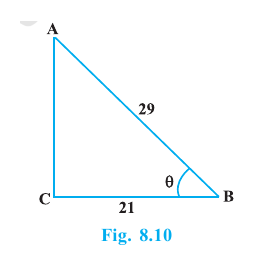
Right triangle ACB, right-angled at C, with BC 21 units, AB 29 units, and angle theta at B.
Figure 8-10 from the supplied NCERT chapter.

Solution

Board-exam working:

AC=AB2BC2=292212=20AC=\sqrt{AB^2-BC^2}=\sqrt{29^2-21^2}=20
sinθ=2029,cosθ=2129\sin\theta=\frac{20}{29},\qquad \cos\theta=\frac{21}{29}

(i)

cos2θ+sin2θ=(2129)2+(2029)2=841841=1\cos^2\theta+\sin^2\theta=\left(\frac{21}{29}\right)^2+\left(\frac{20}{29}\right)^2=\frac{841}{841}=1

(ii)

cos2θsin2θ=212202292=41841\cos^2\theta-\sin^2\theta=\frac{21^2-20^2}{29^2}=\frac{41}{841}

Final answer

(i) 1

(ii) 41841\text{(ii) }\frac{41}{841}

NCERT Example

Example 4

In right triangle ABC, right-angled at B, tan A = 1. Verify that 2 sin A cos A = 1.
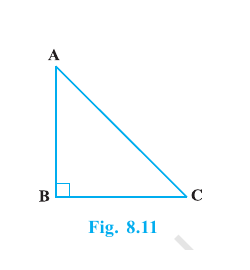
Isosceles right triangle ABC, right-angled at B, used to verify a trigonometric relation.
Figure 8-11 from the supplied NCERT chapter.

Solution

Board-exam working:

tanA=BCAB=1BC=AB\tan A=\frac{BC}{AB}=1\Rightarrow BC=AB

Let AB = BC = k.

AC=k2+k2=k2AC=\sqrt{k^2+k^2}=k\sqrt2
sinA=kk2=12\sin A=\frac{k}{k\sqrt2}=\frac1{\sqrt2}
cosA=kk2=12\cos A=\frac{k}{k\sqrt2}=\frac1{\sqrt2}
2sinAcosA=2(12)(12)=12\sin A\cos A=2\left(\frac1{\sqrt2}\right)\left(\frac1{\sqrt2}\right)=1

Final answer

Verified: 2 sin A cos A = 1.

NCERT Example

Example 5

In right triangle OPQ, right-angled at P, OP = 7 cm and OQ − PQ = 1 cm. Find sin Q and cos Q.
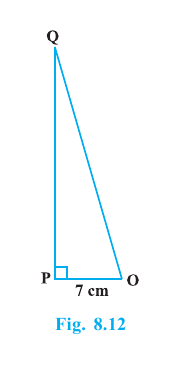
Right triangle OPQ, right-angled at P, with OP equal to 7 centimetres.
Figure 8-12 from the supplied NCERT chapter.

Solution

Board-exam working:

Let PQ = x cm. Then OQ = x + 1 cm.

OQ2=OP2+PQ2OQ^2=OP^2+PQ^2
(x+1)2=72+x2(x+1)^2=7^2+x^2
x2+2x+1=49+x2x^2+2x+1=49+x^2
2x=48x=242x=48\Rightarrow x=24
PQ=24 cm,OQ=25 cmPQ=24\text{ cm},\qquad OQ=25\text{ cm}
sinQ=OPOQ=725\sin Q=\frac{OP}{OQ}=\frac7{25}
cosQ=PQOQ=2425\cos Q=\frac{PQ}{OQ}=\frac{24}{25}

Final answer

sinQ=725,cosQ=2425\sin Q=\frac7{25},\qquad \cos Q=\frac{24}{25}

NCERT Example

Example 6

In right triangle ABC, right-angled at B, AB = 5 cm and angle ACB = 30°. Find BC and AC.
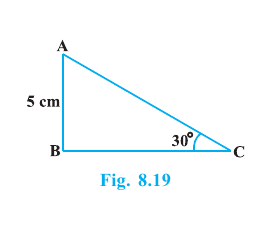
Right triangle ABC, right-angled at B, with AB 5 centimetres and angle C equal to 30 degrees.
Figure 8-19 from the supplied NCERT chapter.

Solution

Board-exam working:

tan30=ABBC\tan30^\circ=\frac{AB}{BC}
13=5BC\frac1{\sqrt3}=\frac5{BC}
BC=53 cmBC=5\sqrt3\text{ cm}
sin30=ABAC\sin30^\circ=\frac{AB}{AC}
12=5AC\frac12=\frac5{AC}
AC=10 cmAC=10\text{ cm}

Final answer

BC = 5√3 cm and AC = 10 cm.

NCERT Example

Example 7

In right triangle PQR, right-angled at Q, PQ = 3 cm and PR = 6 cm. Find angles QPR and PRQ.
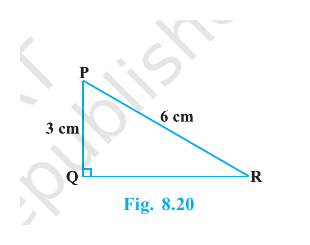
Right triangle PQR, right-angled at Q, with PQ 3 centimetres and PR 6 centimetres.
Figure 8-20 from the supplied NCERT chapter.

Solution

Board-exam working:

sinR=PQPR=36=12\sin R=\frac{PQ}{PR}=\frac36=\frac12
PRQ=30\angle PRQ=30^\circ

The two acute angles of a right triangle are complementary.

QPR=9030=60\angle QPR=90^\circ-30^\circ=60^\circ

Final answer

∠QPR = 60° and ∠PRQ = 30°.

NCERT Example

Example 8

If sin(A − B) = 1/2 and cos(A + B) = 1/2, where 0° < A + B ≤ 90° and A > B, find A and B.

Solution

Board-exam working:

sin(AB)=12AB=30\sin(A-B)=\frac12\Rightarrow A-B=30^\circ
cos(A+B)=12A+B=60\cos(A+B)=\frac12\Rightarrow A+B=60^\circ

Adding the equations:

2A=90A=452A=90^\circ\Rightarrow A=45^\circ

Substituting in A + B = 60°:

45+B=60B=1545^\circ+B=60^\circ\Rightarrow B=15^\circ

Final answer

A = 45° and B = 15°.

NCERT Example

Example 9

Express cos A, tan A and sec A in terms of sin A.

Solution

Board-exam working:

sin2A+cos2A=1\sin^2A+\cos^2A=1
cos2A=1sin2A\cos^2A=1-\sin^2A

Since A is acute, cos A is positive.

cosA=1sin2A\cos A=\sqrt{1-\sin^2A}
tanA=sinAcosA=sinA1sin2A\tan A=\frac{\sin A}{\cos A}=\frac{\sin A}{\sqrt{1-\sin^2A}}
secA=1cosA=11sin2A\sec A=\frac1{\cos A}=\frac1{\sqrt{1-\sin^2A}}

Final answer

cosA=1sin2A,tanA=sinA1sin2A,secA=11sin2A\cos A=\sqrt{1-\sin^2A},\quad \tan A=\frac{\sin A}{\sqrt{1-\sin^2A}},\quad \sec A=\frac1{\sqrt{1-\sin^2A}}

NCERT Example

Example 10

Prove that sec A(1 − sin A)(sec A + tan A) = 1.

Solution

Board-exam working:

Start with the left-hand side:

LHS=secA(1sinA)(secA+tanA)\mathrm{LHS}=\sec A(1-\sin A)(\sec A+\tan A)
=1cosA(1sinA)(1cosA+sinAcosA)=\frac1{\cos A}(1-\sin A)\left(\frac1{\cos A}+\frac{\sin A}{\cos A}\right)
=(1sinA)(1+sinA)cos2A=\frac{(1-\sin A)(1+\sin A)}{\cos^2A}
=1sin2Acos2A=\frac{1-\sin^2A}{\cos^2A}
=cos2Acos2A=1=RHS=\frac{\cos^2A}{\cos^2A}=1=\mathrm{RHS}

Final answer

Hence proved.

NCERT Example

Example 11

Prove that (cot A − cos A)/(cot A + cos A) = (cosec A − 1)/(cosec A + 1).

Solution

Board-exam working:

LHS=cotAcosAcotA+cosA\mathrm{LHS}=\frac{\cot A-\cos A}{\cot A+\cos A}
=cosAsinAcosAcosAsinA+cosA=\frac{\frac{\cos A}{\sin A}-\cos A}{\frac{\cos A}{\sin A}+\cos A}
=cosA(1sinA1)cosA(1sinA+1)=\frac{\cos A\left(\frac1{\sin A}-1\right)}{\cos A\left(\frac1{\sin A}+1\right)}
=cosecA1cosecA+1=RHS=\frac{\cosec A-1}{\cosec A+1}=\mathrm{RHS}

Final answer

Hence proved.

NCERT Example

Example 12

Prove that (sin θ − cos θ + 1)/(sin θ + cos θ − 1) = 1/(sec θ − tan θ), using sec²θ = 1 + tan²θ.

Solution

Board-exam working:

Divide the numerator and denominator of the left-hand side by cos θ:

LHS=tanθ1+secθtanθ+1secθ\mathrm{LHS}=\frac{\tan\theta-1+\sec\theta}{\tan\theta+1-\sec\theta}
=(tanθ+secθ)1(tanθsecθ)+1=\frac{(\tan\theta+\sec\theta)-1}{(\tan\theta-\sec\theta)+1}

Multiply numerator and denominator by tan θ − sec θ:

={(tanθ+secθ)1}(tanθsecθ){(tanθsecθ)+1}(tanθsecθ)=\frac{\{(\tan\theta+\sec\theta)-1\}(\tan\theta-\sec\theta)}{\{(\tan\theta-\sec\theta)+1\}(\tan\theta-\sec\theta)}
=tan2θsec2θtanθ+secθ(tanθsecθ+1)(tanθsecθ)=\frac{\tan^2\theta-\sec^2\theta-\tan\theta+\sec\theta}{(\tan\theta-\sec\theta+1)(\tan\theta-\sec\theta)}
=1tanθ+secθ(tanθsecθ+1)(tanθsecθ)=\frac{-1-\tan\theta+\sec\theta}{(\tan\theta-\sec\theta+1)(\tan\theta-\sec\theta)}
=1tanθsecθ=1secθtanθ=RHS=\frac{-1}{\tan\theta-\sec\theta}=\frac1{\sec\theta-\tan\theta}=\mathrm{RHS}

Final answer

Hence proved.