Mathematics · Coordinate Geometry
NCERT Examples
All 10 worked examples from Coordinate Geometry, with independently verified solutions and direct navigation.
Mathematics · Chapter 7 · NCERT Examples
NCERT Example
Example 1
Do the points P(3, 2), Q(-2, -3) and R(2, 3) form a triangle? If so, name the type of triangle formed.
Solution
Board-exam working:
Using the distance formula:
The sum of any two distances is greater than the third, so the three points form a triangle.
Now:
By the converse of the Pythagoras theorem, ∠P = 90°. Therefore, △PQR is right-angled at P.
Final answer
The points form a right triangle, right-angled at P.
NCERT Example
Example 2
Show that the points A(1, 7), B(4, 2), C(-1, -1) and D(-4, 4) are the vertices of a square.
Solution
Board-exam working:
Using the distance formula for each side:
Now calculate the diagonals:
All four sides are equal and both diagonals are equal. Therefore, ABCD is a square.
Final answer
ABCD is a square.
NCERT Example
Example 3
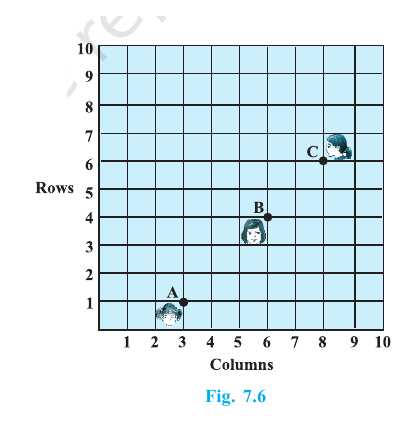
Figure 7.6 shows Ashima, Bharti and Camella seated at A(3, 1), B(6, 4) and C(8, 6). Are they seated in a line? Give reasons.
Solution
Board-exam working:
Using the distance formula:
Now compare the distances:
Since AB + BC = AC, point B lies between A and C. Therefore, A, B and C are collinear.
Final answer
Yes. Ashima, Bharti and Camella are seated in a straight line.
NCERT Example
Example 4
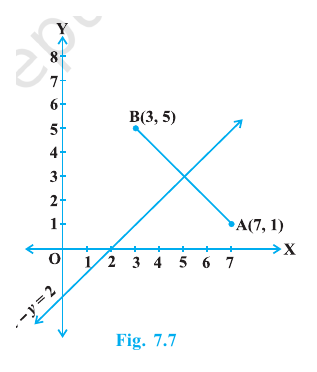
Find a relation between x and y such that P(x, y) is equidistant from A(7, 1) and B(3, 5).
Solution
Board-exam working:
Since P is equidistant from A and B:
Squaring both sides:
Expanding both sides:
Cancelling equal terms and simplifying:
Final answer
The required relation is x - y = 2.
NCERT Example
Example 5
Find a point on the y-axis which is equidistant from A(6, 5) and B(-4, 3).
Solution
Board-exam working:
A point on the y-axis has x-coordinate 0. Let the required point be P(0, y).
Since P is equidistant from A and B:
Squaring both sides:
Expanding:
Cancelling y² and simplifying:
Check:
Thus AP = BP.
Final answer
The required point is (0, 9).
NCERT Example
Example 6
Find the coordinates of the point which divides the line segment joining (4, -3) and (8, 5) internally in the ratio 3 : 1.
Solution
Board-exam working:
Let A(4, -3), B(8, 5), and let P(x, y) divide AB in the ratio 3 : 1.
Using the section formula:
Final answer
The required point is (7, 3).
NCERT Example
Example 7
In what ratio does P(-4, 6) divide the line segment joining A(-6, 10) and B(3, -8)?
Solution
Board-exam working:
Let P divide AB internally in the ratio m₁ : m₂.
Using the x-coordinate in the section formula:
Cross multiplying:
Verification using the y-coordinate:
The y-coordinate agrees with P(-4, 6).
Final answer
The point divides the line segment internally in the ratio 2 : 7.
NCERT Example
Example 8
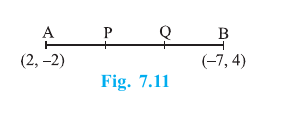
Find the coordinates of the points of trisection of the line segment joining A(2, -2) and B(-7, 4).
Solution
Board-exam working:
Let P and Q be the trisection points, so AP = PQ = QB.
Point P divides AB internally in the ratio 1 : 2.
Point Q divides AB internally in the ratio 2 : 1.
Final answer
The points of trisection are (-1, 0) and (-4, 2).
NCERT Example
Example 9
Find the ratio in which the y-axis divides the line segment joining A(5, -6) and B(-1, -4). Also find the point of intersection.
Solution
Board-exam working:
Let the y-axis divide AB at P in the ratio k : 1.
By the section formula:
Since P lies on the y-axis, its x-coordinate is 0.
Therefore, the ratio is 5 : 1.
Substituting k = 5 in the y-coordinate:
Final answer
The ratio is 5 : 1, and the point of intersection is:
NCERT Example
Example 10
If A(6, 1), B(8, 2), C(9, 4) and D(p, 3) are the vertices of a parallelogram in order, find p.
Solution
Board-exam working:
The diagonals of a parallelogram bisect each other. Therefore, the midpoint of AC equals the midpoint of BD.
Midpoint of AC:
Midpoint of BD:
Equating the x-coordinates:
Final answer
p = 7.