
Mathematics · Quadratic Equations

NCERT Examples

All 9 worked examples from Quadratic Equations, with independently verified solutions and direct navigation.

Mathematics · Chapter 4 · NCERT Examples

Verified NCERT questions and solutionsSolutions are checked independently and follow the supplied NCERT chapter edition.

Jump navigator

Choose a example

NCERT Example

Example 1

Represent the following situations mathematically.

  1. John and Jivanti together have 45 marbles. After each loses 5 marbles, the product of the numbers left is 124.

  2. A cottage industry makes x toys in a day. The cost per toy is ₹(55 − x), and the total cost is ₹750.

Solution

  1. Let John initially have x marbles; Jivanti has 45 − x. After the losses:

    (x−5)(40−x)=124(x-5)(40-x)=124
    −x2+45x−324=0⇒x2−45x+324=0-x^2+45x-324=0\Rightarrow x^2-45x+324=0
  2. Let x be the number of toys. Then:

    x(55−x)=750x(55-x)=750
    x2−55x+750=0x^2-55x+750=0

Final answer

The required equations are x² − 45x + 324 = 0 and x² − 55x + 750 = 0.

NCERT Example

Example 2

Check whether each equation is quadratic.

  1. (x−2)2+1=2x−3(x-2)^2+1=2x-3
  2. x(x+1)+8=(x+2)(x−2)x(x+1)+8=(x+2)(x-2)
  3. x(2x+3)=x2+1x(2x+3)=x^2+1
  4. (x+2)3=x3−4(x+2)^3=x^3-4

Solution

  1. x2−4x+5=2x−3⇒x2−6x+8=0x^2-4x+5=2x-3\Rightarrow x^2-6x+8=0

    Quadratic.

  2. x2+x+8=x2−4⇒x+12=0x^2+x+8=x^2-4\Rightarrow x+12=0

    Not quadratic.

  3. 2x2+3x=x2+1⇒x2+3x−1=02x^2+3x=x^2+1\Rightarrow x^2+3x-1=0

    Quadratic.

  4. x3+6x2+12x+8=x3−4⇒x2+2x+2=0x^3+6x^2+12x+8=x^3-4\Rightarrow x^2+2x+2=0

    Quadratic after dividing by 6.

NCERT Example

Example 3

Find the roots of 2x² − 5x + 3 = 0 by factorisation.

Solution

2x2−5x+3=2x2−2x−3x+32x^2-5x+3=2x^2-2x-3x+3
=2x(x−1)−3(x−1)=(2x−3)(x−1)=2x(x-1)-3(x-1)=(2x-3)(x-1)
2x−3=0orx−1=02x-3=0 \text{or} x-1=0
x=32orx=1x=\frac32 \text{or} x=1

Substitution in the original equation gives zero for both roots.

Final answer

x=1,32x=1, \frac32

NCERT Example

Example 4

Find the roots of 6x² − x − 2 = 0.

Solution

6x2−x−2=6x2+3x−4x−26x^2-x-2=6x^2+3x-4x-2
=3x(2x+1)−2(2x+1)=(3x−2)(2x+1)=3x(2x+1)-2(2x+1)=(3x-2)(2x+1)
3x−2=0or2x+1=03x-2=0 \text{or} 2x+1=0
x=23orx=−12x=\frac23 \text{or} x=-\frac12

Each value satisfies the original quadratic.

Final answer

x=23,−12x=\frac23, -\frac12

NCERT Example

Example 5

Find the roots of 3x2−26x+2=0.\text{Find the roots of }3x^2-2\sqrt6x+2=0.

Solution

3x2−26x+2=3x2−6x−6x+23x^2-2\sqrt6x+2=3x^2-\sqrt6x-\sqrt6x+2
=(3x−2)2=(\sqrt3x-\sqrt2)^2
3x−2=0⇒x=23\sqrt3x-\sqrt2=0\Rightarrow x=\sqrt{\frac23}

The repeated factor gives the same root twice; substitution gives 0.

Final answer

x=23,23x=\sqrt{\frac23}, \sqrt{\frac23}

NCERT Example

Example 6

Find the dimensions of a prayer hall whose breadth is x metres, length is 2x + 1 metres, and area is 300 m².

Solution

x(2x+1)=300⇒2x2+x−300=0x(2x+1)=300\Rightarrow2x^2+x-300=0
2x2−24x+25x−300=02x^2-24x+25x-300=0
(x−12)(2x+25)=0(x-12)(2x+25)=0
x=12orx=−252x=12 \text{or} x=-\frac{25}{2}

Breadth cannot be negative, so −12.5 is rejected. The length is 2(12) + 1 = 25 m.

Final answer

Breadth = 12 m and length = 25 m.

NCERT Example

Example 7

Find the discriminant of 2x² − 4x + 3 = 0 and hence state the nature of its roots.

Solution

a=2,b=−4,c=3a=2,\quad b=-4,\quad c=3
D=b2−4ac=(−4)2−4(2)(3)=16−24=−8D=b^2-4ac=(-4)^2-4(2)(3)=16-24=-8

Since D < 0, the equation has no real roots.

Final answer

D = −8; no real roots.

NCERT Example

Example 8

A pole is to be placed on the boundary of a circular park of diameter 13 m so that its distances from diametrically opposite gates differ by 7 m. Determine whether this is possible and find the distances.
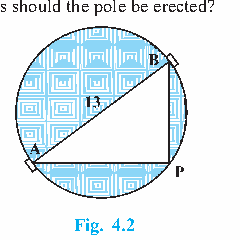
A circular park with diameter AB, point P on the circumference, and right triangle APB.
Figure 4.2: the pole P and diametrically opposite gates A and B.

Solution

Let BP = x m, so AP = x + 7 m. Since angle APB is 90°:

(x+7)2+x2=132(x+7)^2+x^2=13^2
x2+7x−60=0x^2+7x-60=0
a=1,b=7,c=−60a=1,\quad b=7,\quad c=-60
D=72−4(1)(−60)=289D=7^2-4(1)(-60)=289
x=−7±2892=5or−12x=\frac{-7\pm\sqrt{289}}2=5 \text{or} -12

Distance cannot be negative, so −12 is rejected. Thus BP = 5 m and AP = 12 m; 5² + 12² = 13² verifies the geometry.

Final answer

Yes. The pole is 5 m from one gate and 12 m from the other.

NCERT Example

Example 9

Find the discriminant and roots of 3x2−2x+13=0.\text{Find the discriminant and roots of }3x^2-2x+\frac13=0.

Solution

a=3,b=−2,c=13a=3,\quad b=-2,\quad c=\frac13
D=(−2)2−4(3)(13)=0D=(-2)^2-4(3)\left(\frac13\right)=0
x=−b2a=26=13x=\frac{-b}{2a}=\frac{2}{6}=\frac13

D = 0, so this root is repeated; substitution in the original equation gives 0.

Final answer

x=13,13x=\frac13, \frac13

Study assistant

Padhona AI

Ask about anything you’re studying.

Contextual study help

Ask about what you’re studying

Sign in to use contextual Padhona AI on study pages.

  • Padhona AI understands the question you’re viewing
  • Ask about a step without copying the whole question
  • Free accounts get 10 contextual messages per day