Mathematics · Polynomials
NCERT Examples
All 5 worked examples from Polynomials, with independently verified solutions and direct navigation.
Mathematics · Chapter 2 · NCERT Examples
NCERT Example
Example 1
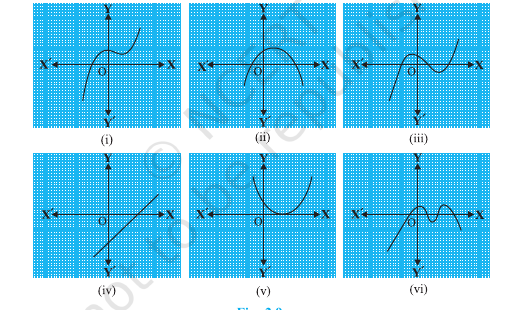
Look at the graphs in Figure 2.9. Each is the graph of y = p(x), where p(x) is a polynomial. For each graph, find the number of zeroes of p(x).
Solution
The graph intersects the x-axis once, so it has 1 zero.
The graph intersects the x-axis twice, so it has 2 zeroes.
The graph intersects the x-axis three times, so it has 3 zeroes.
The graph intersects the x-axis once, so it has 1 zero.
The graph touches the x-axis once, so it has 1 zero.
The graph intersects the x-axis four times, so it has 4 zeroes.
Final answer
The numbers of zeroes are 1, 2, 3, 1, 1 and 4 respectively.
NCERT Example
Example 2
Find the zeroes of the quadratic polynomial x² + 7x + 10, and verify the relationship between the zeroes and the coefficients.
Solution
Thus the zeroes are −2 and −5.
Final answer
The zeroes are −2 and −5; their sum is −7 and product is 10.
NCERT Example
Example 3
Find the zeroes of the polynomial x² − 3 and verify the relationship between the zeroes and the coefficients.
Solution
The zeroes are √3 and −√3.
Final answer
The zeroes are √3 and −√3; their sum is 0 and product is −3.
NCERT Example
Example 4
Find a quadratic polynomial whose zeroes have sum −3 and product 2.
Solution
Every non-zero real multiple of this polynomial has the same zeroes.
Final answer
NCERT Example
Example 5
Verify that 3, −1 and −1/3 are the zeroes of p(x) = 3x³ − 5x² − 11x − 3, and verify the relationship between the zeroes and the coefficients.
Solution
Final answer
All three values are zeroes, and the sum, pairwise-product sum and product agree with the coefficient relationships.