Mathematics · Probability · NCERT Exercises
Exercise 14.1
Complete, independently verified solutions for NCERT Exercise 14.1.
Mathematics · Chapter 14 · NCERT Exercises
Question
Question 1
Complete the statements: (i) P(E) + P(not E) = ___. (ii) The probability of an event that cannot happen is ___; it is called an ___ event. (iii) The probability of an event certain to happen is ___; it is called a ___ event. (iv) The sum of the probabilities of all elementary events of an experiment is ___. (v) The probability of an event is greater than or equal to ___ and less than or equal to ___.
Solution
Board-exam working:
(i) Complementary probabilities always add to 1.
(ii) An event that cannot occur has probability 0 and is called an impossible event.
(iii) An event certain to occur has probability 1 and is called a sure or certain event.
(iv) The elementary events together form the complete sample space, so their probabilities add to 1.
(v) Every probability lies between 0 and 1, inclusive.
Final answer
(i) 1; (ii) 0, impossible; (iii) 1, sure/certain; (iv) 1; (v) 0, 1.
Question
Question 2
Which experiments have equally likely outcomes? Explain: (i) a driver attempts to start a car; it starts or does not start, (ii) a player attempts a basketball shot; the shot goes in or is missed, (iii) a true-false question is answered; the answer is right or wrong, (iv) a baby is born; it is a boy or a girl.
Solution
Board-exam working:
(i) Not equally likely. The car's condition and the driver's action affect whether it starts.
(ii) Not equally likely. The player's skill and the difficulty of the shot affect the outcome.
(iii) Treated as equally likely when the answer is chosen at random from the two alternatives.
(iv) Treated as equally likely in this elementary probability model.
Final answer
Experiments (iii) and (iv) are treated as having equally likely outcomes; (i) and (ii) are not.
Question
Question 3
Why is tossing a coin considered a fair way of deciding which football team gets the ball at the beginning of a game?
Solution
Board-exam working:
A fair coin is unbiased and has two possible outcomes: head and tail.
Giving one outcome to each team therefore gives both teams the same chance.
Final answer
Because head and tail are equally likely, each team has probability 1/2 of winning the toss.
Question
Question 4
Which value cannot be the probability of an event: (A) 2/3, (B) -1.5, (C) 15%, (D) 0.7?
Solution
Board-exam working:
A probability must satisfy:
Therefore -1.5 cannot be a probability.
Final answer
Question
Question 5
If P(E) = 0.05, find P(not E).
Solution
Board-exam working:
Final answer
Question
Question 6
A bag contains lemon-flavoured candies only. One candy is drawn without looking. Find the probability that it is (i) orange flavoured and (ii) lemon flavoured.
Solution
Board-exam working:
(i) The bag contains no orange candy, so drawing one is impossible.
(ii) Every candy is lemon flavoured, so drawing one is certain.
Final answer
Question
Question 7
In a group of 3 students, the probability that two students do not have the same birthday is 0.992. Find the probability that the two students have the same birthday.
Solution
Board-exam working:
Having the same birthday and not having the same birthday are complementary events.
Final answer
Question
Question 8
A bag contains 3 red balls and 5 black balls. One ball is drawn at random. Find the probability that it is (i) red and (ii) not red.
Solution
Board-exam working:
(i) Favourable red balls = 3.
(ii) A ball that is not red is black. Favourable black balls = 5.
Final answer
Question
Question 9
A box contains 5 red, 8 white and 4 green marbles. One marble is drawn at random. Find the probability that it is (i) red, (ii) white and (iii) not green.
Solution
Board-exam working:
(i) Red marbles = 5.
(ii) White marbles = 8.
(iii) Marbles that are not green = red + white.
Final answer
Question
Question 10
A piggy bank contains 100 fifty-paise coins, 50 one-rupee coins, 20 two-rupee coins and 10 five-rupee coins. One coin falls out at random. Find the probability that it (i) is a 50-paise coin and (ii) is not a five-rupee coin.
Solution
Board-exam working:
Total number of coins:
(i) Number of 50-paise coins = 100.
(ii) Coins that are not five-rupee coins:
Final answer
Question
Question 11
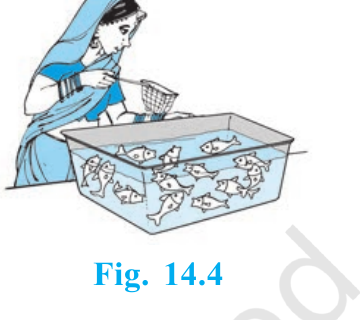
A shopkeeper selects one fish at random from a tank containing 5 male fish and 8 female fish. Find the probability that the selected fish is male.
Solution
Board-exam working:
Total fish in the tank:
Number of favourable outcomes = number of male fish = 5.
Final answer
Question
Question 12
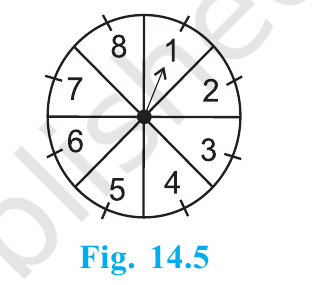
A spinner has eight equal sectors numbered 1 to 8. Find the probability that it points at (i) 8, (ii) an odd number, (iii) a number greater than 2 and (iv) a number less than 9.
Solution
Board-exam working:
(i) Only one sector is numbered 8.
(ii) The odd sectors are 1, 3, 5 and 7.
(iii) The numbers greater than 2 are 3, 4, 5, 6, 7 and 8.
(iv) Every number on the spinner is less than 9.
Final answer
Question
Question 13
A die is thrown once. Find the probability of getting (i) a prime number, (ii) a number lying between 2 and 6 and (iii) an odd number.
Solution
Board-exam working:
(i) Prime numbers are 2, 3 and 5.
(ii) Numbers strictly between 2 and 6 are 3, 4 and 5.
(iii) Odd numbers are 1, 3 and 5.
Final answer
Question
Question 14
One card is drawn from a well-shuffled deck of 52 cards. Find the probability of getting (i) a red king, (ii) a face card, (iii) a red face card, (iv) the jack of hearts, (v) a spade and (vi) the queen of diamonds.
Solution
Board-exam working:
(i) Red kings: king of hearts and king of diamonds, so there are 2.
(ii) Each suit has a jack, queen and king. Therefore there are 3 × 4 = 12 face cards.
(iii) The two red suits each contain 3 face cards, so there are 6 red face cards.
(iv) There is one jack of hearts.
(v) There are 13 spades.
(vi) There is one queen of diamonds.
Final answer
Question
Question 15
The ten, jack, queen, king and ace of diamonds are shuffled face down. One card is picked. (i) Find the probability that it is the queen. (ii) If the queen is drawn and put aside, find the probability that the second card is (a) an ace and (b) a queen.
Solution
Board-exam working:
(i) Initially there are 5 equally likely cards and one queen.
(ii) After the queen is removed, 4 cards remain: ten, jack, king and ace.
(a) Exactly one of the remaining cards is an ace.
(b) No queen remains.
Final answer
Question
Question 16
Twelve defective pens are mixed with 132 good pens. One pen is selected at random. Find the probability that it is good.
Solution
Board-exam working:
Total number of pens:
Number of favourable good pens = 132.
Final answer
Question
Question 17
A lot of 20 bulbs contains 4 defective bulbs. (i) One bulb is drawn at random. Find the probability that it is defective. (ii) Suppose that bulb is not defective and is not replaced. A second bulb is drawn from the remainder. Find the probability that the second bulb is not defective.
Solution
Board-exam working:
(i) There are 4 defective bulbs among 20 bulbs.
(ii) Initially, the number of good bulbs is:
One good bulb was drawn and not replaced, so 15 good bulbs remain among 19 bulbs.
Final answer
Question
Question 18
A box contains 90 discs numbered 1 to 90. One disc is drawn at random. Find the probability that its number is (i) a two-digit number, (ii) a perfect square and (iii) divisible by 5.
Solution
Board-exam working:
(i) Two-digit numbers in the sample space run from 10 through 90.
(ii) Perfect squares up to 90:
(iii) Multiples of 5 from 5 to 90:
Final answer
Question
Question 19
The six faces of a die show A, B, C, D, E and A. The die is thrown once. Find the probability of getting (i) A and (ii) D.
Solution
Board-exam working:
The six faces are equally likely.
(i) The letter A appears on 2 faces.
(ii) The letter D appears on 1 face.
Final answer
Question
Question 20
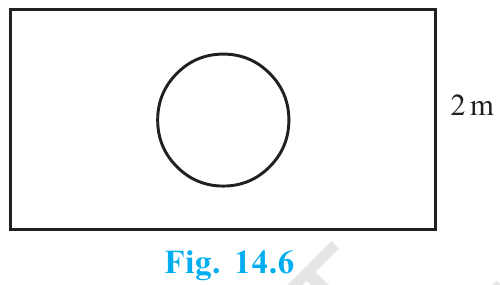
A die is dropped at random on the 3 m by 2 m rectangular region shown. Find the probability that it lands inside the circle of diameter 1 m.
NCERT marks this question as not from the examination point of view.
Solution
Board-exam working:
Area of the rectangular region:
The circle has radius half its diameter.
Area of the circle:
Using π = 22/7:
Final answer
Question
Question 21
A lot has 144 ball pens, of which 20 are defective. Nuri buys a pen if it is good. One pen is drawn at random. Find the probability that (i) she buys it and (ii) she does not buy it.
Solution
Board-exam working:
Number of good pens:
(i) She buys the pen when it is good.
(ii) She does not buy the pen when it is defective.
Check:
Final answer
Question
Question 22
Refer to the experiment of throwing two dice. (i) Complete the probability table for sums 2 through 12. (ii) A student claims that the 11 possible sums are equally likely and each has probability 1/11. Decide whether the claim is correct and justify the answer.
Solution
Board-exam working:
There are 36 equally likely ordered pairs. Count the pairs producing each sum.
Sum | Favourable pairs | Probability |
|---|---|---|
2 | 1 | 1/36 |
3 | 2 | 2/36 |
4 | 3 | 3/36 |
5 | 4 | 4/36 |
6 | 5 | 5/36 |
7 | 6 | 6/36 |
8 | 5 | 5/36 |
9 | 4 | 4/36 |
10 | 3 | 3/36 |
11 | 2 | 2/36 |
12 | 1 | 1/36 |
(ii) The claim is incorrect because the sums do not have the same number of favourable ordered pairs.
Therefore the 11 sums are not equally likely.
Final answer
Question
Question 23
A one-rupee coin is tossed three times. Hanif wins if all three tosses give the same result, and loses otherwise. Find the probability that Hanif loses.
Solution
Board-exam working:
List the eight equally likely outcomes:
Hanif wins only for HHH and TTT.
Therefore he loses for the remaining outcomes.
Final answer
Question
Question 24
A die is thrown twice. Find the probability that (i) 5 does not appear either time and (ii) 5 appears at least once.
Solution
Board-exam working:
Two throws give 6 × 6 = 36 equally likely ordered pairs.
(i) On each throw, any of 1, 2, 3, 4 or 6 is allowed. Thus there are 5 × 5 favourable pairs.
(ii) Getting at least one 5 is the complement of getting no 5.
Final answer
Question
Question 25
Decide whether each argument is correct. (i) Two coins give three outcomes: two heads, two tails or one of each, so each has probability 1/3. (ii) A die gives either an odd or an even number, so the probability of an odd number is 1/2.
Solution
Board-exam working:
(i) Incorrect. The four equally likely elementary outcomes are:
Two heads occurs once, two tails occurs once, but one of each occurs twice.
The three stated events are therefore not equally likely.
(ii) Correct. The equally likely die outcomes are 1, 2, 3, 4, 5 and 6.
The odd outcomes are 1, 3 and 5.
Final answer
(i) Incorrect; the probabilities are 1/4, 1/4 and 1/2. (ii) Correct; P(odd) = 1/2.