Padhona

Mathematics · Surface Areas and Volumes

NCERT Examples

All 7 worked examples from Surface Areas and Volumes, with independently verified solutions and direct navigation.

Mathematics · Chapter 12 · NCERT Examples

Verified NCERT questions and solutionsSolutions are checked independently and follow the supplied NCERT chapter edition.

Jump navigator

Choose a example

NCERT Example

Example 1

A playing top is shaped like a cone surmounted by a hemisphere. Its total height is 5 cm and its diameter is 3.5 cm. Find the area to be coloured. Take π = 22/7.
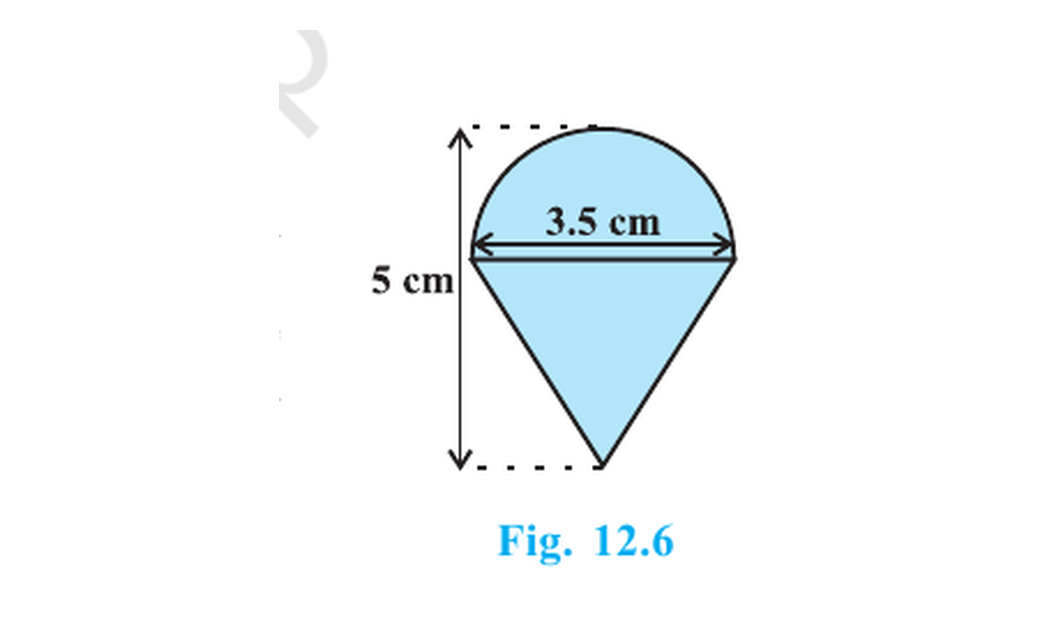
Playing top formed by a hemisphere over a cone, total height 5 centimetres and diameter 3.5 centimetres.
Figure 12-6 from the supplied NCERT chapter.

Solution

Board-exam working:

The common radius is half the diameter.

r=3.52=1.75 cmr=\frac{3.5}{2}=1.75\text{ cm}

Height of the conical part:

h=51.75=3.25 cmh=5-1.75=3.25\text{ cm}

Slant height of the cone:

l=r2+h2=1.752+3.252l=\sqrt{r^2+h^2}=\sqrt{1.75^2+3.25^2}
=13.6253.7 cm=\sqrt{13.625}\approx3.7\text{ cm}

Only the curved surfaces of the hemisphere and cone are exposed.

A=2πr2+πrl=πr(2r+l)A=2\pi r^2+\pi rl=\pi r(2r+l)
=227×1.75×(3.5+3.7)=\frac{22}{7}\times1.75\times(3.5+3.7)
=39.6 cm2 (approximately)=39.6\text{ cm}^2\text{ (approximately)}

Final answer

39.6 cm2 (approximately)\boxed{39.6\text{ cm}^2\text{ (approximately)}}

NCERT Example

Example 2

A decorative block is made of a cube of edge 5 cm with a hemisphere of diameter 4.2 cm fixed on top. Find its total surface area. Take π = 22/7.
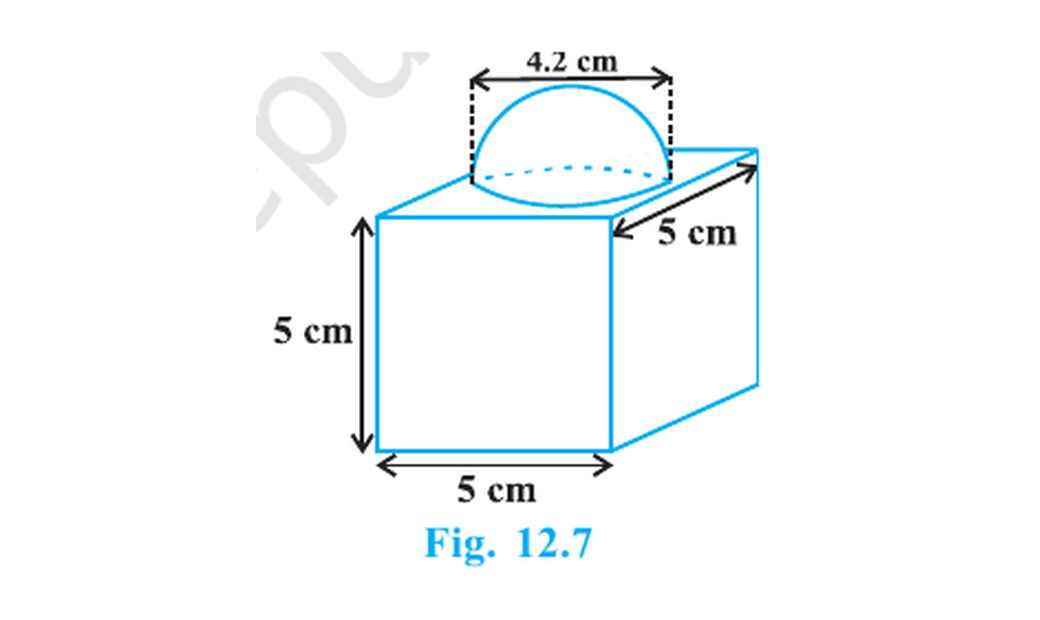
Decorative block formed by a hemisphere of diameter 4.2 centimetres on a cube of edge 5 centimetres.
Figure 12-7 from the supplied NCERT chapter.

Solution

Board-exam working:

r=4.22=2.1 cmr=\frac{4.2}{2}=2.1\text{ cm}

The circular part of the cube covered by the hemisphere is not exposed.

A=6a2πr2+2πr2A=6a^2-\pi r^2+2\pi r^2
=6(5)2+π(2.1)2=6(5)^2+\pi(2.1)^2
=150+227×2.1×2.1=150+\frac{22}{7}\times2.1\times2.1
=150+13.86=163.86 cm2=150+13.86=163.86\text{ cm}^2

Final answer

163.86 cm2\boxed{163.86\text{ cm}^2}

NCERT Example

Example 3

A wooden toy rocket is a cone mounted on a cylinder. Its total height is 26 cm, the conical part is 6 cm high, the cone diameter is 5 cm and the cylinder diameter is 3 cm. Find the areas painted orange on the cone and yellow on the cylinder. Take π = 3.14.
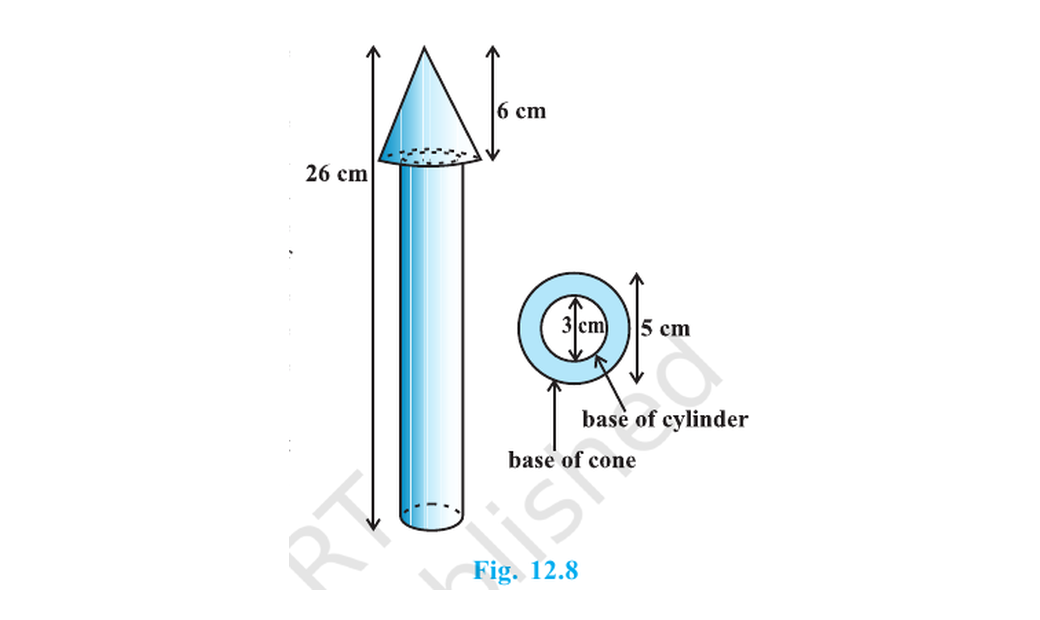
Toy rocket formed by a cone on a cylinder, with all heights and diameters labelled.
Figure 12-8 from the supplied NCERT chapter.

Solution

Board-exam working:

For the cone:

r=2.5 cm,h=6 cmr=2.5\text{ cm},\qquad h=6\text{ cm}

For the cylinder:

r=1.5 cm,h=266=20 cmr'=1.5\text{ cm},\qquad h'=26-6=20\text{ cm}

Slant height of the cone:

l=2.52+62=42.25=6.5 cml=\sqrt{2.5^2+6^2}=\sqrt{42.25}=6.5\text{ cm}

Orange area = curved area of cone + exposed ring at its base.

Ao=πrl+πr2π(r)2A_o=\pi rl+\pi r^2-\pi(r')^2
=3.14[(2.5)(6.5)+(2.5)2(1.5)2]=3.14[(2.5)(6.5)+(2.5)^2-(1.5)^2]
=3.14(20.25)=63.585 cm2=3.14(20.25)=63.585\text{ cm}^2

Yellow area = curved area and bottom base of the cylinder.

Ay=2πrh+π(r)2A_y=2\pi r'h'+\pi(r')^2
=3.14(1.5)[2(20)+1.5]=3.14(1.5)[2(20)+1.5]
=4.71(41.5)=195.465 cm2=4.71(41.5)=195.465\text{ cm}^2

Final answer

Ao=63.585 cm2,Ay=195.465 cm2A_o=63.585\text{ cm}^2,\qquad A_y=195.465\text{ cm}^2

NCERT Example

Example 4

A bird-bath is a cylinder with a hemispherical depression at one end. The cylinder is 1.45 m high and has radius 30 cm. Find its total surface area. Take π = 22/7.
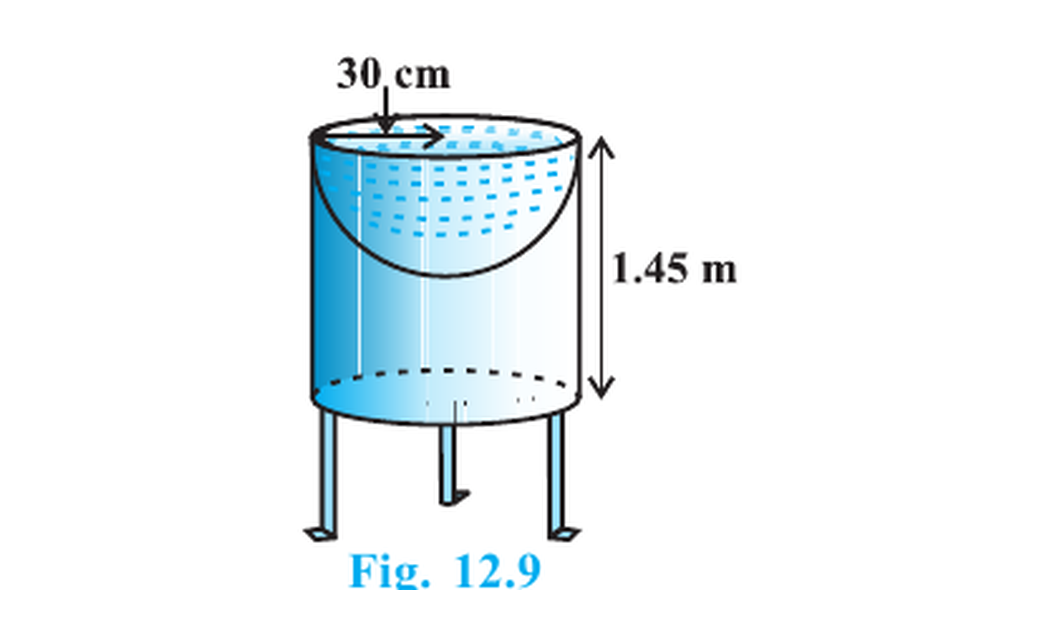
Cylindrical bird-bath with a hemispherical depression, radius 30 centimetres and height 1.45 metres.
Figure 12-9 from the supplied NCERT chapter.

Solution

Board-exam working:

Use one unit throughout.

h=1.45 m=145 cm,r=30 cmh=1.45\text{ m}=145\text{ cm},\qquad r=30\text{ cm}

The exposed area is the curved surface of the cylinder plus the curved surface of the depression.

A=2πrh+2πr2=2πr(h+r)A=2\pi rh+2\pi r^2=2\pi r(h+r)
=2×227×30×(145+30)=2\times\frac{22}{7}\times30\times(145+30)
=33000 cm2=33000\text{ cm}^2
=3300010000=3.3 m2=\frac{33000}{10000}=3.3\text{ m}^2

Final answer

3.3 m2\boxed{3.3\text{ m}^2}

NCERT Example

Example 5

A shed is a cuboid surmounted by a half-cylinder. Its base is 7 m × 15 m and its cuboidal part is 8 m high. Find the volume of air it can hold. Machinery occupies 300 m³ and 20 workers occupy 0.08 m³ each. Find the air left in the occupied shed. Take π = 22/7.
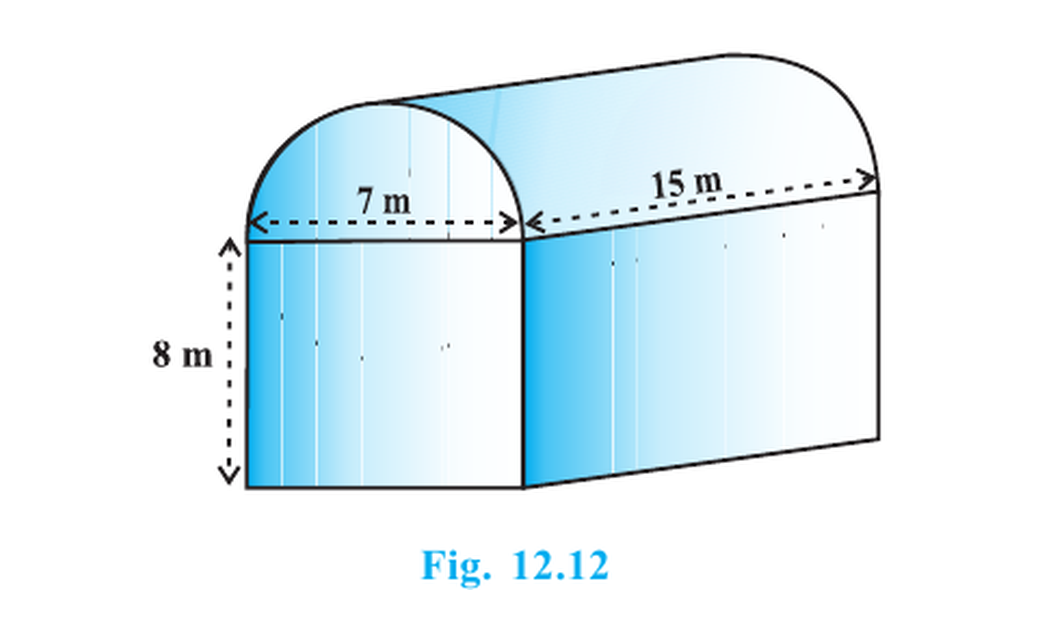
Industrial shed formed by a cuboid and half-cylinder roof, labelled 15 metres, 7 metres and 8 metres.
Figure 12-12 from the supplied NCERT chapter.

Solution

Board-exam working:

Cuboid dimensions: 15 m × 7 m × 8 m.

Vc=15×7×8=840 m3V_c=15\times7\times8=840\text{ m}^3

The half-cylinder has radius 7/2 m and length 15 m.

Vh=12πr2lV_h=\frac12\pi r^2l
=12×227×(72)2×15=288.75 m3=\frac12\times\frac{22}{7}\times\left(\frac72\right)^2\times15=288.75\text{ m}^3

Total empty volume:

V=840+288.75=1128.75 m3V=840+288.75=1128.75\text{ m}^3

Space occupied by workers:

20×0.08=1.6 m320\times0.08=1.6\text{ m}^3

Air left after machinery and workers occupy space:

1128.75(300+1.6)=827.15 m31128.75-(300+1.6)=827.15\text{ m}^3

Final answer

Vempty=1128.75 m3,Vair=827.15 m3V_{empty}=1128.75\text{ m}^3,\qquad V_{air}=827.15\text{ m}^3

NCERT Example

Example 6

A cylindrical glass has inner diameter 5 cm and height 10 cm. Its bottom has a hemispherical raised portion. Find its apparent and actual capacities. Use π = 3.14.
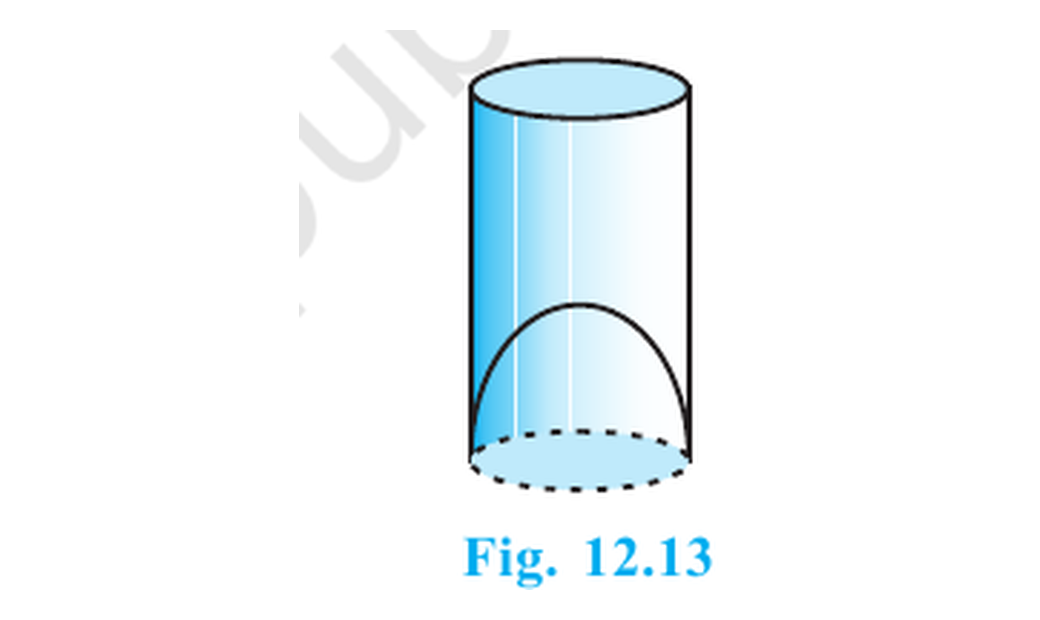
Cylindrical glass with a hemispherical raised portion at its base.
Figure 12-13 from the supplied NCERT chapter.

Solution

Board-exam working:

r=52=2.5 cm,h=10 cmr=\frac52=2.5\text{ cm},\qquad h=10\text{ cm}

Apparent capacity is the full cylindrical volume.

Va=πr2h=3.14×2.52×10=196.25 cm3V_a=\pi r^2h=3.14\times2.5^2\times10=196.25\text{ cm}^3

The raised hemisphere occupies:

Vh=23πr3=23×3.14×2.53V_h=\frac23\pi r^3=\frac23\times3.14\times2.5^3
32.71 cm3\approx32.71\text{ cm}^3

Actual capacity:

V=196.2532.71=163.54 cm3V=196.25-32.71=163.54\text{ cm}^3

Final answer

Va=196.25 cm3,V=163.54 cm3V_a=196.25\text{ cm}^3,\qquad V=163.54\text{ cm}^3

NCERT Example

Example 7

A toy is a hemisphere surmounted by a right circular cone. The cone is 2 cm high and the common base diameter is 4 cm. Find the toy's volume. A right circular cylinder circumscribes the toy; find the difference between the cylinder's volume and the toy's volume. Take π = 3.14.
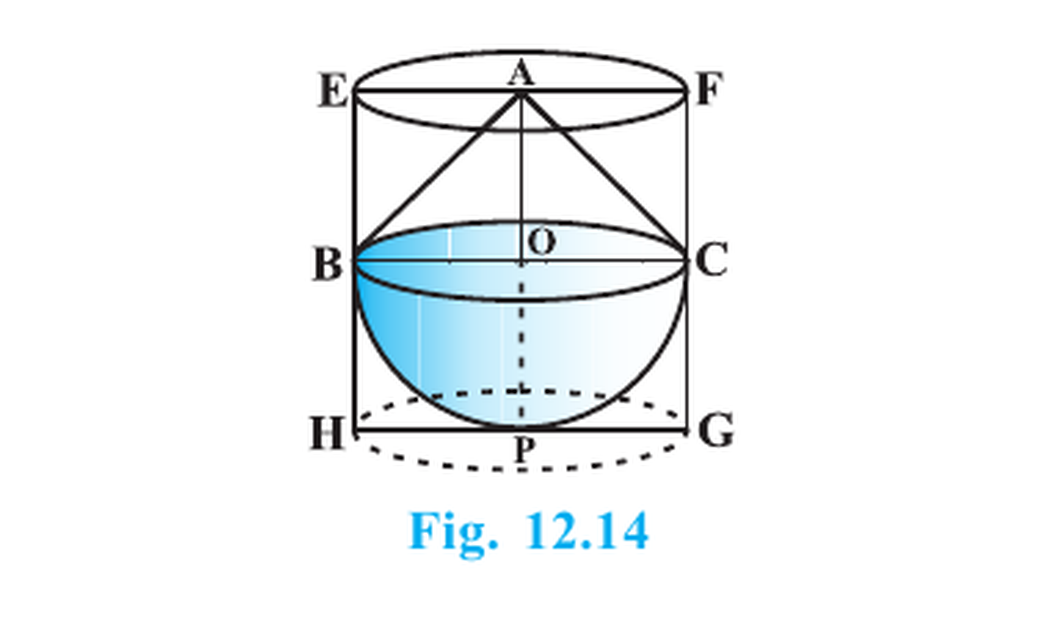
Cone over a hemisphere circumscribed by a right circular cylinder, with points A to H, O and P labelled.
Figure 12-14 from the supplied NCERT chapter.

Solution

Board-exam working:

r=42=2 cm,hcone=2 cmr=\frac42=2\text{ cm},\qquad h_{cone}=2\text{ cm}

Volume of the toy:

Vt=23πr3+13πr2hV_t=\frac23\pi r^3+\frac13\pi r^2h
=23(3.14)(2)3+13(3.14)(2)2(2)=\frac23(3.14)(2)^3+\frac13(3.14)(2)^2(2)
=25.12 cm3=25.12\text{ cm}^3

The circumscribing cylinder has radius 2 cm and height 2 + 2 = 4 cm.

Vc=πr2H=3.14×22×4=50.24 cm3V_c=\pi r^2H=3.14\times2^2\times4=50.24\text{ cm}^3

Required difference:

VcVt=50.2425.12=25.12 cm3V_c-V_t=50.24-25.12=25.12\text{ cm}^3

Final answer

Vt=25.12 cm3,VcVt=25.12 cm3V_t=25.12\text{ cm}^3,\qquad V_c-V_t=25.12\text{ cm}^3