Mathematics · Circles · NCERT Exercises
Exercise 10.2
Complete, independently verified solutions for NCERT Exercise 10.2.
Mathematics · Chapter 10 · NCERT Exercises
Question
Question 1
From a point Q, a tangent to a circle has length 24 cm and the distance from Q to the centre is 25 cm. Find the radius. Options: (A) 7 cm, (B) 12 cm, (C) 15 cm, (D) 24.5 cm.
Solution
Board-exam working:
Let QT = 24 cm be the tangent and OQ = 25 cm. Radius OT is perpendicular to QT.
Final answer
Option (A): 7 cm.
Question
Question 2
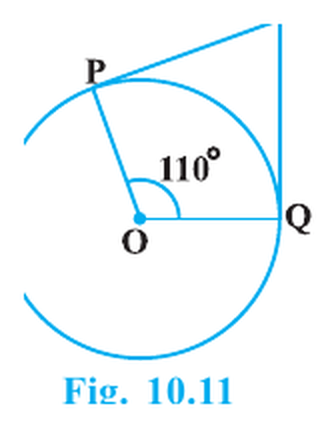
In Figure 10.11, TP and TQ are tangents to a circle with centre O and ∠POQ = 110°. Find ∠PTQ. Options: (A) 60°, (B) 70°, (C) 80°, (D) 90°.
Solution
Board-exam working:
Radii OP and OQ are perpendicular to tangents TP and TQ.
In quadrilateral OPTQ:
Final answer
Option (B): 70°.
Question
Question 3
Tangents PA and PB from a point P to a circle with centre O are inclined at 80°. Find ∠POA. Options: (A) 50°, (B) 60°, (C) 70°, (D) 80°.
Solution
Board-exam working:
Radii OA and OB are perpendicular to the tangents.
In quadrilateral OAPB:
Triangles OAP and OBP are congruent, so OP bisects ∠AOB.
Final answer
Option (A): 50°.
Question
Question 4
Prove that the tangents drawn at the ends of a diameter of a circle are parallel.
Solution
Board-exam working:
Let AB be a diameter. Let lines ℓ and m be the tangents at A and B.
A tangent is perpendicular to the radius through its point of contact.
OA and OB lie on the same straight line AB.
Two lines perpendicular to the same line are parallel.
Final answer
Hence, the tangents at the ends of a diameter are parallel.
Question
Question 5
Prove that the perpendicular at the point of contact to the tangent to a circle passes through the centre.
Solution
Board-exam working:
Let line ℓ touch the circle at P and let O be the centre.
By the tangent-radius theorem, the radius through the point of contact is perpendicular to the tangent.
Through a given point P, only one line can be drawn perpendicular to ℓ.
Therefore, the perpendicular to ℓ at P is the line OP itself.
Final answer
Hence proved.
Question
Question 6
The length of a tangent from point A, which is 5 cm from the centre of a circle, is 4 cm. Find the radius.
Solution
Board-exam working:
Let AP = 4 cm be the tangent, O the centre and OP = r.
In right triangle OPA:
Final answer
The radius is 3 cm.
Question
Question 7
Two concentric circles have radii 5 cm and 3 cm. Find the length of a chord of the larger circle that touches the smaller circle.
Solution
Board-exam working:
Let chord AB of the larger circle touch the smaller circle at P. Join OP.
The perpendicular from the centre bisects the chord, so AP = PB.
In right triangle OPA, OA = 5 cm and OP = 3 cm.
Final answer
The chord is 8 cm long.
Question
Question 8
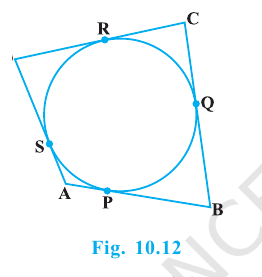
A quadrilateral ABCD circumscribes a circle as shown in Figure 10.12. Prove that AB + CD = AD + BC.
Solution
Board-exam working:
Let the circle touch AB, BC, CD and DA at P, Q, R and S respectively.
Tangents from the same external point are equal.
Now add the lengths of opposite sides:
Final answer
Hence, AB + CD = AD + BC.
Question
Question 9
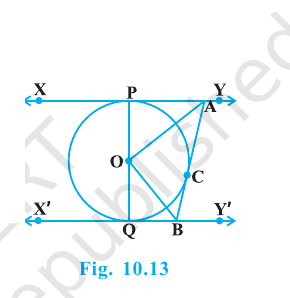
In Figure 10.13, XY and X′Y′ are parallel tangents to a circle with centre O. Another tangent AB touches at C and meets XY at A and X′Y′ at B. Prove that ∠AOB = 90°.
Solution
Board-exam working:
Let P, C and Q be the points of contact of the tangents through A and B.
From A, AP and AC are equal tangents. Therefore, AO bisects ∠PAC.
From B, BQ and BC are equal tangents. Therefore, BO bisects ∠CBQ.
Since XY is parallel to X′Y′ and AB is a transversal:
In triangle AOB:
Final answer
Hence, ∠AOB = 90°.
Question
Question 10
Prove that the angle between two tangents drawn from an external point is supplementary to the angle subtended at the centre by the segment joining the points of contact.
Solution
Board-exam working:
Let PA and PB be tangents from external point P to a circle with centre O.
The radii are perpendicular to the tangents.
In quadrilateral OAPB:
Thus the angle between the tangents and the central angle subtended by AB are supplementary.
Final answer
Hence proved.
Question
Question 11
Prove that a parallelogram circumscribing a circle is a rhombus.
Solution
Board-exam working:
Let parallelogram ABCD circumscribe a circle.
For any quadrilateral circumscribing a circle:
Opposite sides of a parallelogram are equal.
Substitute these equalities:
A parallelogram with two adjacent sides equal has all four sides equal.
Final answer
Therefore, the parallelogram is a rhombus.
Question
Question 12
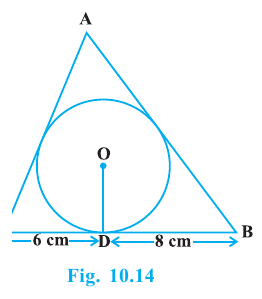
Triangle ABC circumscribes a circle of radius 4 cm. The point of contact D divides BC into BD = 8 cm and DC = 6 cm. Find AB and AC.
Solution
Board-exam working:
Let the circle touch AB and AC at F and E. Tangents from the same point are equal.
Let AF = AE = x cm.
The semiperimeter is:
Area using the inradius r = 4 cm:
Area using Heron's formula:
Equating the two expressions and squaring:
Final answer
AB = 15 cm and AC = 13 cm.
Question
Question 13
Prove that opposite sides of a quadrilateral circumscribing a circle subtend supplementary angles at the centre.
Solution
Board-exam working:
Let quadrilateral ABCD circumscribe a circle with centre O.
The line joining a vertex to O bisects the angle between the two tangents from that vertex.
In triangle AOB:
Similarly, in triangle COD:
Since the angle sum of a quadrilateral is 360°:
Similarly:
Final answer
Hence, each pair of opposite sides subtends supplementary angles at O.