Mathematics · Circles
NCERT Examples
All 3 worked examples from Circles, with independently verified solutions and direct navigation.
Mathematics · Chapter 10 · NCERT Examples
NCERT Example
Example 1
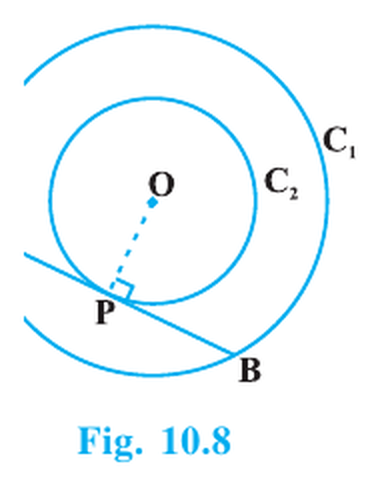
Prove that in two concentric circles, a chord of the larger circle that touches the smaller circle is bisected at the point of contact.
Solution
Board-exam working:
Let the two circles have common centre O. Chord AB of the larger circle touches the smaller circle at P.
Join OP.
Since AB is tangent to the smaller circle at P, its radius OP is perpendicular to AB.
AB is also a chord of the larger circle. The perpendicular from the centre of a circle to a chord bisects the chord.
Final answer
Hence, the chord AB is bisected at P.
NCERT Example
Example 2
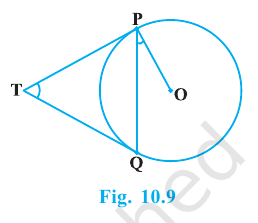
Two tangents TP and TQ are drawn from an external point T to a circle with centre O. Prove that ∠PTQ = 2∠OPQ.
Solution
Board-exam working:
Let ∠PTQ = θ.
Tangents from the same external point are equal.
Therefore, triangle TPQ is isosceles.
The radius OP is perpendicular to tangent TP.
Final answer
Hence proved: ∠PTQ = 2∠OPQ.
NCERT Example
Example 3
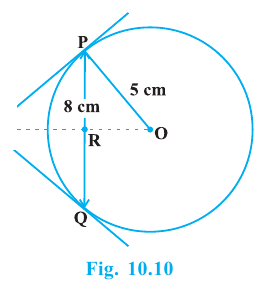
PQ is a chord of length 8 cm in a circle of radius 5 cm. The tangents at P and Q meet at T. Find TP.
Solution
Board-exam working:
Join OT and let it meet PQ at R.
Since TP = TQ, triangle TPQ is isosceles. OT bisects ∠PTQ and is perpendicular to PQ.
In right triangle OPR:
Triangles TRP and PRO are similar by AA similarity.